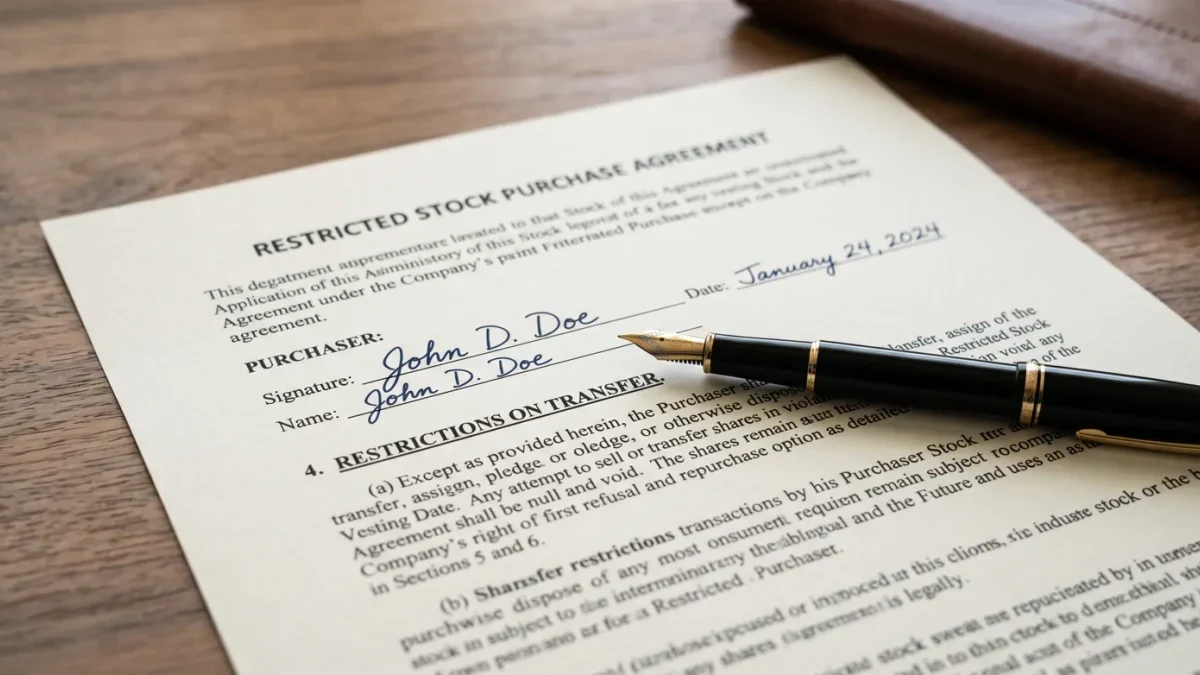
Equity splits go wrong in two symmetrical ways: an equal split that ignores unequal contribution, and a founder-heavy split that demotes the person doing half the work. Both fail the same test — they were decided in a single conversation before reality had a vote. The durable approach treats the split as a computation over contribution and risk, wrapped in a vesting schedule so that a co-founder who leaves early does not walk away with permanent ownership. Orer News publishes information, not legal advice; a startup attorney should paper whatever you decide.
The document that makes any split real is the vesting agreement, not the handshake.
What actually determines a fair split?
Four factors carry most of the weight. Time commitment, current and planned: a founder going full-time before revenue deserves materially more than one staying employed. Idea and prior work: the original concept and any pre-company IP matter, though founders routinely overprice them — ideas are abundant; execution is scarce. Capital: money actually invested, treated as either a premium on equity or a loan, but never silently. Skills and network: the specific capability the company cannot easily hire. Many founding teams score each factor explicitly and let the arithmetic propose the split, then adjust by judgment — the exercise matters more than its precision because it forces the conversation before the resentment.
Why does vesting protect everyone?
Standard founder vesting runs four years with a one-year cliff: nothing vests until twelve months of service, then monthly. The purpose is not distrust — it is the answer to the departure scenario. A co-founder who exits in month eight with 30 percent unvested turns the company into a fund-raising pariah, because every future investor asks why a third of the cap table is dead weight. Vesting also gives the remaining founders a mechanism — unvested shares return to the pool — instead of a lawsuit. The SBA and essentially every startup law practice treat a written vesting schedule as table stakes for multi-founder companies.
What about the equal split?
Equal splits work when contributions genuinely are equal — same risk, same full-time commitment, complementary but comparable skills. The danger is defaulting to 50/50 to avoid an uncomfortable conversation, which embeds the avoided conversation into the company's structure permanently. Equal splits also need a tie-breaker: a buy-sell or shotgun clause, or a defined deciding founder, because a 50/50 deadlock with no mechanism is how companies die between milestones. If the split is equal by computation, fine; if it is equal by cowardice, revisit it now, not at the Series A.
How does the structure handle later arrivals?
Early employees get options from a pool — commonly 10 to 15 percent of total equity — reserved at formation or first institutional round, not ad hoc slices of founder shares. Late-joining co-founders receive equity with vesting from their start date and a grant sized to their coming contribution, not retroactive credit for the company's past. And every transfer, repurchase right, and restriction belongs in the operating agreement or bylaws: equity without transfer restrictions means a departing founder can sell shares to anyone, including a competitor of the remaining founders' hopes.
- Score time, idea, capital, and skills explicitly
- Four-year vesting, one-year cliff, for every founder
- Equal splits need a written deadlock mechanism
- Reserve 10–15% option pool before the first hire
The split conversation is cheap today and expensive forever. Have it with numbers, vest it in writing, and let the company's future be decided by its work rather than by its first argument.