Plenty of side hustles run lawfully for years as sole proprietorships — the moment you earn your first dollar selling something, you already are one, with no filing required. The question is when that default stops being adequate, and the triggers are risk, deal size, and perception, not a revenue threshold the IRS does not actually have. Orer News publishes information, not legal or tax advice.
Roughly, the upgrade decision arrives when one of three things happens: the downside of a lawsuit stops being theoretical, customers or platforms start requiring a real entity, or the tax and fee arithmetic begins to favor a structure.
What risks does the default expose?
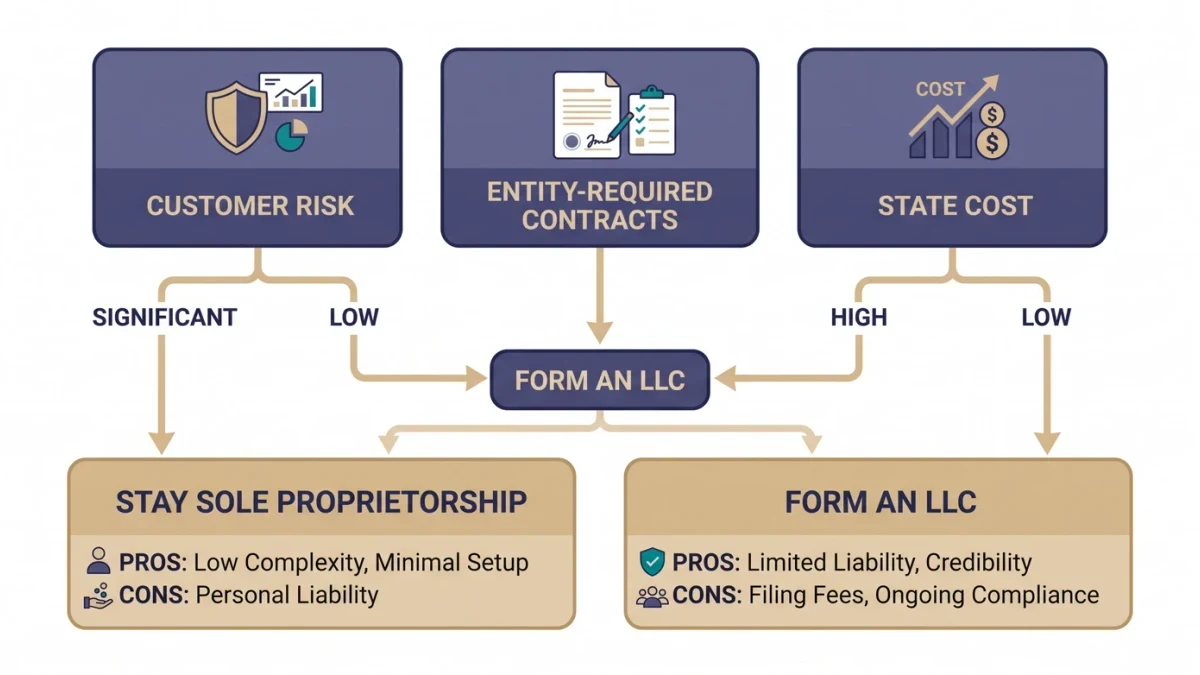
A sole proprietorship has unlimited personal liability — a customer injury, a defective product, a copyright dispute over a logo all reach personal assets directly. That exposure scales with what the hustle actually does: a freelance writer's risk profile differs from someone selling physical goods or advising clients on decisions worth money. The LLC's function is the liability wall, and it holds only when respected: separate account, no commingling, contracts signed in the company's name. Buying liability insurance is a separate decision that many hustles should make first or simultaneously — insurance pays claims; the entity limits what a claimant can reach.
What do customers and counterparties demand?
Practical triggers often arrive from outside. Enterprise clients commonly refuse to pay individuals and require a W-9 from an entity with an EIN; platforms and marketplaces in some categories require business accounts; commercial leases and many supplier agreements are entity-only. A federal EIN — free from the IRS — also stops you handing your Social Security number to every client, which is a privacy argument independent of liability. None of this requires an LLC by law; all of it makes one convenient at a certain deal size.
What do states charge for the privilege?
Formation runs roughly $50 to $500 depending on state, plus recurring annual fees — and a few states charge meaningfully more, with California's $800 annual franchise tax the canonical example. Registered agents, operating agreements, and an EIN are the other standard line items. The arithmetic test is crude but honest: if annual state costs approach the hassle-savings and risk-reduction value the entity provides, wait; if a single contract's liability exposure dwarfs them, do not. Note also that the LLC does not change federal taxation by default — a single-member LLC files the same Schedule C as before, so the tax complexity arrives only if you elect otherwise.
How do you run both without trouble?
The employer relationship comes first: check any moonlighting, non-compete, or IP-assignment clauses in your employment agreement — intellectual property created in the same field as your job can belong to the employer under invention-assignment terms. Keep hours and equipment strictly separated, and never build the side business on the employer's tools or data. Then apply the same hygiene any LLC needs: business account from the first entity dollar, contracts in the entity's name, and clean books so the Schedule C the LLC still files is defensible.
| Trigger | Action |
|---|---|
| Physical product or client-facing risk | Insurance first, entity close behind |
| Enterprise clients requiring W-9/EIN | EIN minimum; LLC when liability matters |
| State fees approach value received | Stay sole proprietorship for now |
| Employer IP-assignment clause | Attorney review before building |
The entity is infrastructure, not a milestone. Upgrade it when the business's risk, customers, or arithmetic demand it — and spend the months before that on the only thing that ever made any of this matter: revenue.