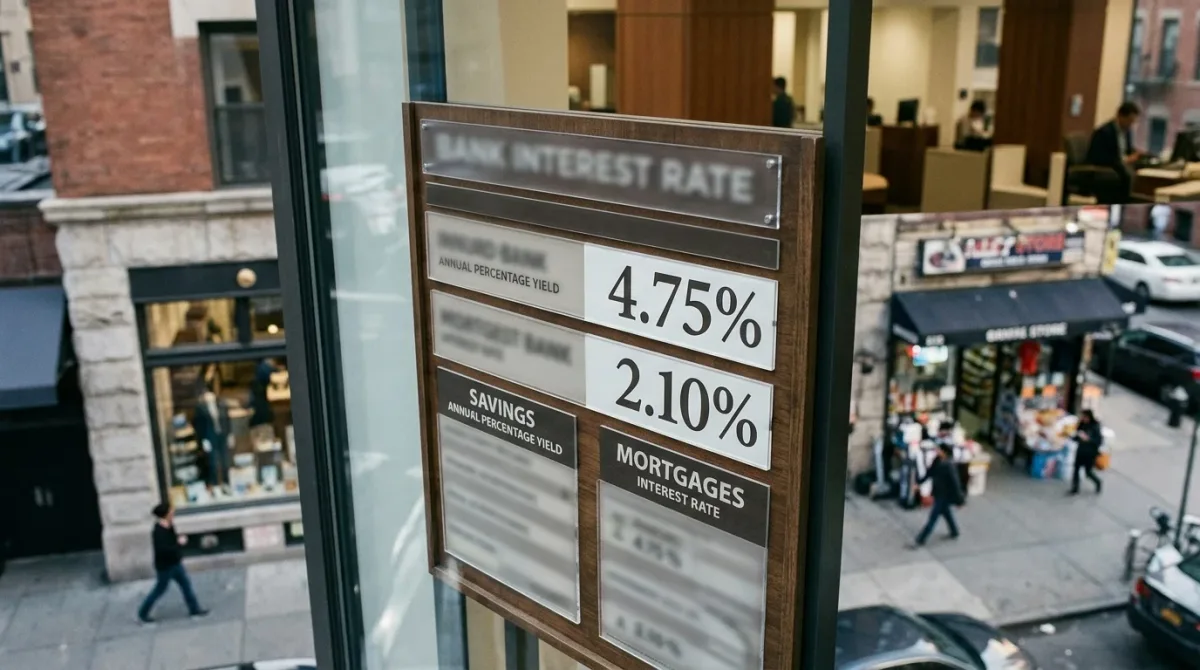
The prime rate that prices most small-business variable loans held at 6.75% for the week of Aug. 13-19, 2026, per the Federal Reserve's H.15 release — unchanged since the Fed kept its target range at 3.50%-3.75% on July 29, 2026. No reprice this cycle, but knowing the mechanics matters before the next one.
This is information, not lending or investment advice. Rates below are published figures as of the dates shown; they change without notice.
What Changed at the Fed's July 29 Meeting?
Nothing, and that is the news for an operator with a variable-rate loan. The Federal Open Market Committee "decided to maintain the target range for the federal funds rate at 3-1/2 to 3-3/4 percent," according to the Fed's own statement issued July 29, 2026 — the same range it had held since at least the prior meeting in June. The federal funds rate is what banks charge each other overnight; it does not touch your loan directly. What touches your loan is the prime rate, and the Fed's own H.15 statistical release shows the bank prime loan rate sitting at 6.75% for the week of Aug. 13-19, 2026, the release dated Aug. 20, 2026.
How Does the Prime Rate Reach a Business Loan?
Most bank lines of credit and many SBA loans are priced as "prime plus a spread," and the spread — not the Fed — is set in your loan agreement. The prime rate itself is defined, for SBA lending purposes, as the rate "in effect on the first business day of the month, as printed in a national financial newspaper published each business day," per federal regulation 13 CFR 120.214. In practice, prime moves in step with the Fed's target range, typically landing three percentage points above the upper end of it — which is exactly where the current 6.75% sits above the Fed's 3.75% upper bound. A held Fed rate means a held prime rate; a change at the next FOMC meeting would move both, but on a lender-set reset date, not the meeting date itself.
Does This Apply to a Regular Bank Line of Credit Too?
Yes, and without the SBA's caps. A conventional, non-SBA bank line of credit is not bound by the spread limits in 13 CFR 120.214 — those caps apply specifically to SBA-guaranteed 7(a) lending. A bank is free to price a standard commercial line at prime plus whatever spread the borrower's credit profile and relationship support. That makes the loan agreement, not a published regulation, the only place to confirm the spread on a non-SBA line. The same mechanic still holds: the index is usually prime, the margin is fixed in the contract, and the payment only moves when the index does.
What Does 6.75% Prime Mean for an SBA 7(a) Loan?
SBA 7(a) loans cap how much a lender can add on top of the base rate, and the cap shrinks as the loan gets bigger. The maximum spreads, set out in 13 CFR 120.214 and echoed on SBA's own lender guidance page, are as follows, with the resulting maximum variable rate at today's 6.75% prime:
| Loan amount | Maximum spread over prime | Maximum variable rate today |
|---|---|---|
| $50,000 or less | 6.5 percentage points | 13.25% |
| $50,001–$250,000 | 6.0 percentage points | 12.75% |
| $250,001–$350,000 | 4.5 percentage points | 11.25% |
| Over $350,000 | 3.0 percentage points | 9.75% |
Those are ceilings, not the rate every borrower pays — the actual spread is negotiated between borrower and lender inside that cap. A lender can charge less. It cannot charge more. If your 7(a) note is priced above these figures for its loan-size tier, that itself is worth a call to the lender.
Fixed-Rate Loan or Card — Does Any of This Apply to You?
Not directly. A fixed-rate SBA loan or term loan locked its rate at origination; the Fed holding or moving does not change the payment. Only loans and lines explicitly tied to a floating index — prime, most commonly, for small-business lending — reprice when that index moves. Business credit cards are typically variable and prime-linked too, so a card statement is often the fastest place to see this mechanic in action: check the "how your APR is calculated" disclosure box, which states the index and the margin the issuer adds.
What to Check Before the Next Fed Decision
Three things determine what a rate move actually does to your payment, and none of them is the Fed's calendar:
- Confirm the index. Ask the lender or read the note: is it tied to prime, to SOFR, or is it fixed? Not every "variable" small-business loan uses the same benchmark.
- Find the reset date. Variable loans reprice on a schedule set in the contract — monthly, quarterly, or on each prime-rate change — not on the day of an FOMC statement.
- Know your spread. The gap between the index and what you pay is fixed by the note even when the index moves; a wider spread means the same Fed move costs you more in dollar terms.
Check the reset date. Then call the lender if the math on your note does not match the published caps above.
Why the Fed and Prime Move Together, but Not Always Together
Prime is not set by the Fed. It is a rate individual banks publish, and by long-standing practice the major banks have kept it at roughly three percentage points above the top of the Fed's target range — which is why 6.75% lines up with the Fed's 3.75% upper bound today. That gap is a market convention, not a rule, so a lender is not required to move prime the moment the FOMC changes its target — which is one more reason the loan agreement's own reset language, not the FOMC's press release, is what actually determines the date a variable-rate small-business loan repriced.
For a related entrepreneurship perspective, read Fed Holds Rates Steady, SBA Loan Costs Stay at 6.75%.