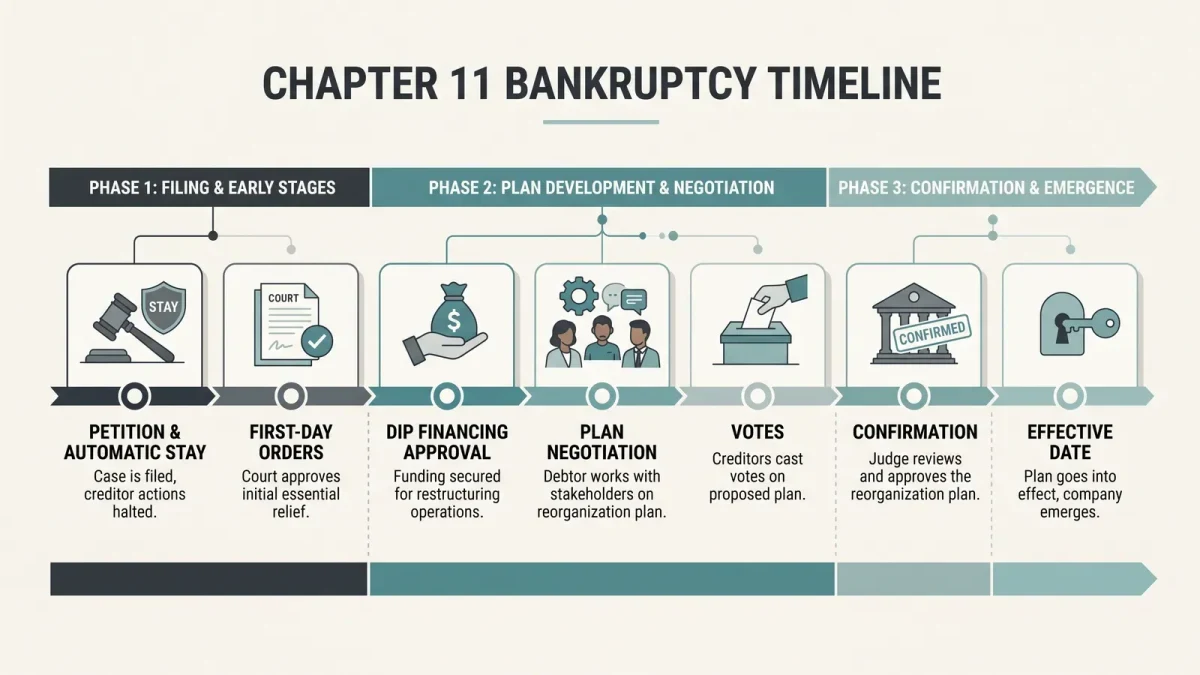
A customer's Chapter 11 filing converts your receivable into a bankruptcy claim in a legal process with its own calendar, priorities, and vocabulary. The automatic stay stops all collection instantly; what follows is a negotiation over a shrinking pool. Administrative law firms and the U.S. Trustee's oversight shape the details, but for a vendor the economics come down to three questions: what kind of claim you hold, whether the debtor needs you going forward, and whether you hold anything collateral-like. Orer News publishes information, not legal advice.
Chapter 11 aims to reorganize, not liquidate — which is why debtors frequently keep buying from critical suppliers while old balances sit frozen.
What happens to the money already owed?
Pre-petition receivables become general unsecured claims in most cases — the back of the line, behind secured lenders, administrative costs of running the case, and priority wage and tax claims. General unsecured recoveries in retail and similar cases have often run to cents on the dollar, occasionally zero. The exceptions worth knowing: reclamation claims for goods delivered in the 45 days before the filing, which must be asserted quickly in writing; deposits you hold — or, more often, deposits the customer holds for goods not yet delivered, which become priority claims; and liens or security interests documented before the filing, which put you ahead of the unsecured line entirely. The lesson written into every credit policy: your real security is what you hold before the petition date, not what the contract says after.
What is critical vendor status?
Debtors need suppliers to keep operating, so courts routinely allow payment of pre-petition balances to vendors the business cannot replace — typically in exchange for agreement to normal trade terms going forward. Selection is the debtor's, approved by the court, and it converts a back-of-line claim into something closer to full payment for the chosen few. The practical stance: if you are genuinely irreplaceable, say so early and in writing to debtor's counsel; if you are one of five interchangeable suppliers, critical vendor relief is not a plan, and the honest response is rethinking exposure.
How do you protect the relationship going forward?
Post-petition sales are a different legal world: goods and services delivered after the filing are administrative-priority claims, paid in the ordinary course, and debtors in Chapter 11 typically need credit terms to keep operating. Vendors who demand cash-advance payment for post-petition shipments can find themselves in administrative-claim disputes anyway if the case fails; vendors who extend normal terms to a debtor-in-possession are taking a calculated risk that the reorganized company — or a buyer of its assets — emerges as a paying customer. The midpoint most credit managers land on: standard terms post-petition, tightened limits, and a watched DIP budget.
What should change before the next filing?
Concentration: one customer at 40 percent of receivables is a bankruptcy exposure, not a sales achievement. Instruments: deposits, letters of credit, credit insurance, and retained title or security interests where the transaction supports them, all arranged while the counterparty is healthy — none of them available after. Monitoring: payment-speed deterioration, credit-limit creep, and public filings are the leading indicators; a customer stretching from 30 to 75 days is telling you something no factor will. And paperwork: reclamation and deposit claims die on deadlines measured in days.
- Old invoices become unsecured claims — plan on cents
- Assert reclamation within days if goods shipped in the last 45
- Post-petition sales are priority claims, but keep limits tight
- Real protection is arranged pre-petition: deposits, liens, insurance
Bankruptcy is a system for allocating losses that already happened. Vendors who understand their lane in it recover more; vendors who also arranged their protection before the petition recover most.