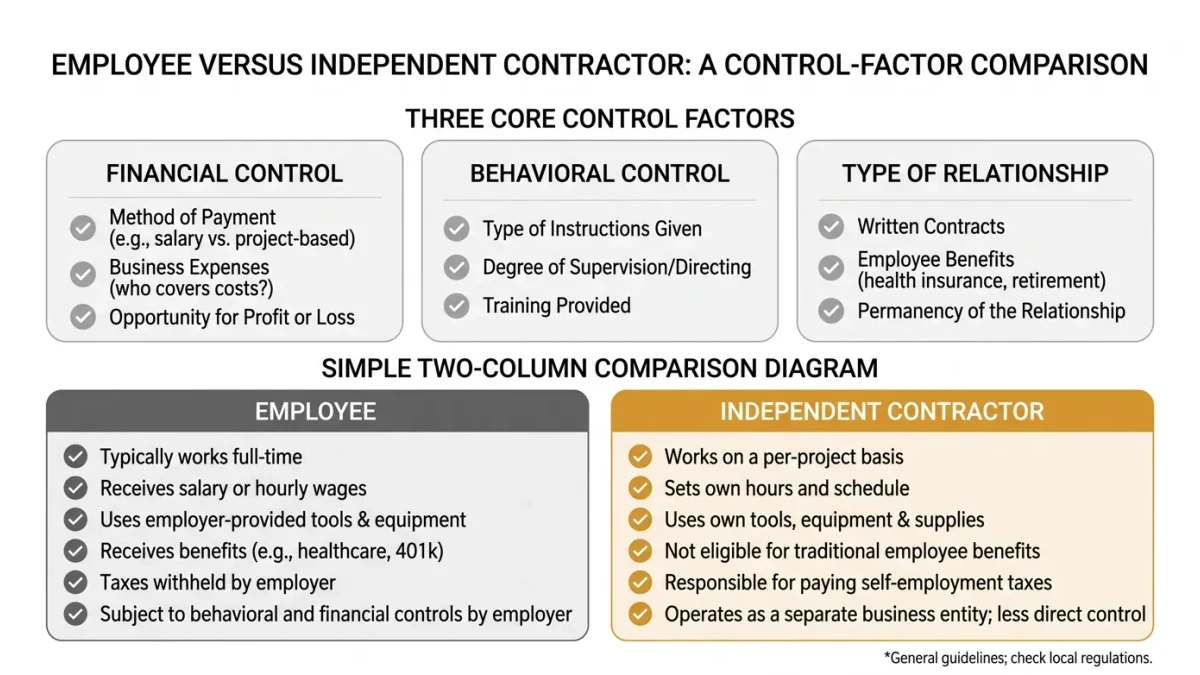
Calling a worker a contractor does not make one. Federal law — under the Fair Labor Standards Act, as the U.S. Department of Labor clarified in its 2024 independent contractor rule — applies an economic-realities test asking whether the worker is in business for themselves or economically dependent on the employer. Getting it wrong means retroactive payroll taxes, unpaid overtime, penalties, and in some cases benefits claims. The Department of Labor estimated misclassification affects a meaningful share of the workforce, and enforcement is not theoretical. Orer News publishes information, not legal advice.
The IRS runs its own version for tax purposes, states run stricter ones still — California's ABC test being the famous example — so a compliant arrangement must satisfy the strictest applicable regime, not an average of them.
What does the economic-realities test weigh?
The DOL rule frames six non-exclusive factors: the opportunity for profit or loss depending on managerial skill; investments by the worker and the potential employer; the degree of permanence of the relationship; the nature and degree of control; whether the work is integral to the business; and skill and initiative. No single factor decides, and labels, job titles, and signed contractor agreements carry essentially no weight. What carries weight is how the relationship actually operates — which is why the audit evidence that decides these cases is the day-to-day record.
Which facts most often sink the classification?
Control in practice: set schedules, mandatory meetings, instructions on how rather than what, company equipment and accounts. Permanence and exclusivity: a worker serving only you, indefinitely, on your premises, is presenting as an employee whatever the invoice says. Integrality: if the work is the business's core product, dependence is hard to deny. A genuine contractor, by contrast, has their own tools and business identity, multiple clients, sets their own methods and hours, prices their services, and can profit or lose on their own management — the plumber who fixes your office once is not your employee; the person who staffs your front desk indefinitely is.
What does misclassification actually cost?
The exposure stacks: employer-side FICA and unemployment taxes for the lookback period, with penalties and interest; unpaid overtime under the FLSA, liquidated damages of an equal amount; state labor-code penalties, which in several states accrue per pay period; and benefit-plan claims if misclassified workers argue they were entitled to health coverage or retirement participation the plan documents extended to employees. Worker-classification lawsuits and DOL actions settle for sums that dwarf the payroll savings involved.
How do you structure a compliant contractor relationship?
Behaviorally: contract for outcomes, not supervision — deliverables, deadlines, and standards rather than hours, methods, or training. Practically: require a business identity — EIN, business bank account, their own tools and insurance; pay by invoice on milestones, not on a salary-like schedule; allow genuine parallel clients and do not impose exclusivity; keep engagements project-scoped and time-bounded, renewed deliberately rather than rolling forever. Document the factors as they actually stand, and revisit long-running contractors annually, because permanence is a factor that grows against you with time.
| Signal | Points toward contractor | Points toward employee |
|---|---|---|
| Control | Sets own methods and hours | Schedule and instructions set |
| Clients | Multiple, markets freely | Works only for you |
| Tools and risk | Own tools, can profit or lose | Your equipment, steady pay |
| Scope | Project-defined, finite | Indefinite, integral work |
The classification is a facts test that arrives years after the habits were formed. Businesses that audit their own arrangements now — against the strictest test they are subject to — buy certainty at the only price it is ever sold.