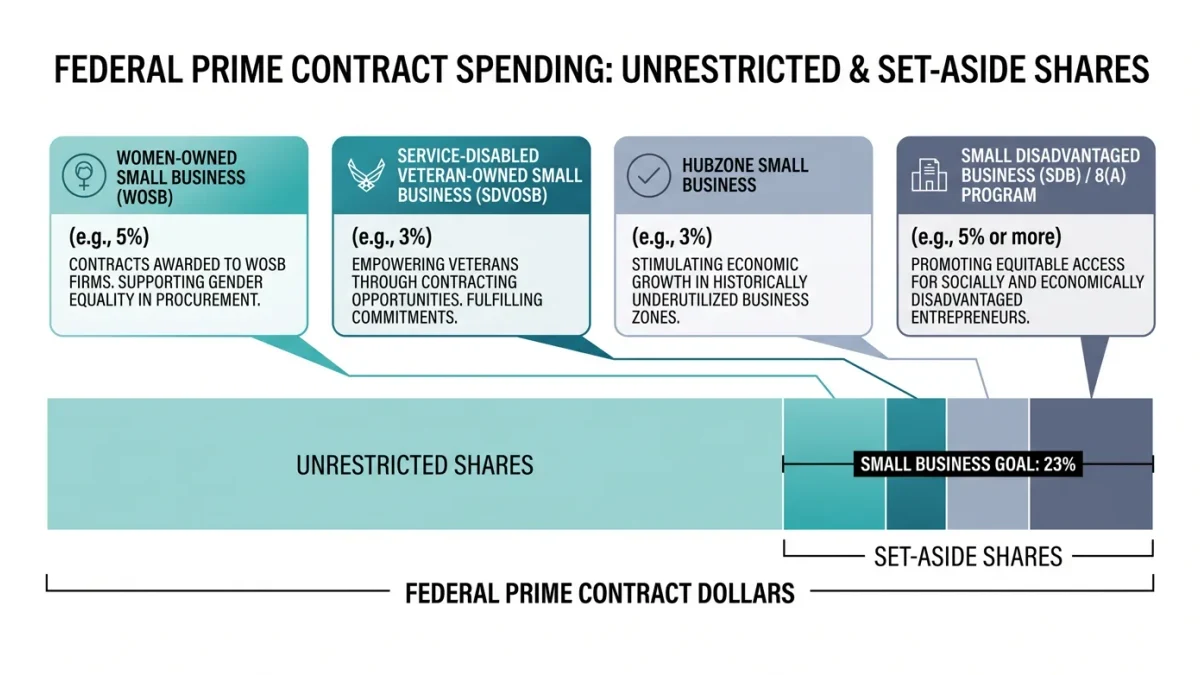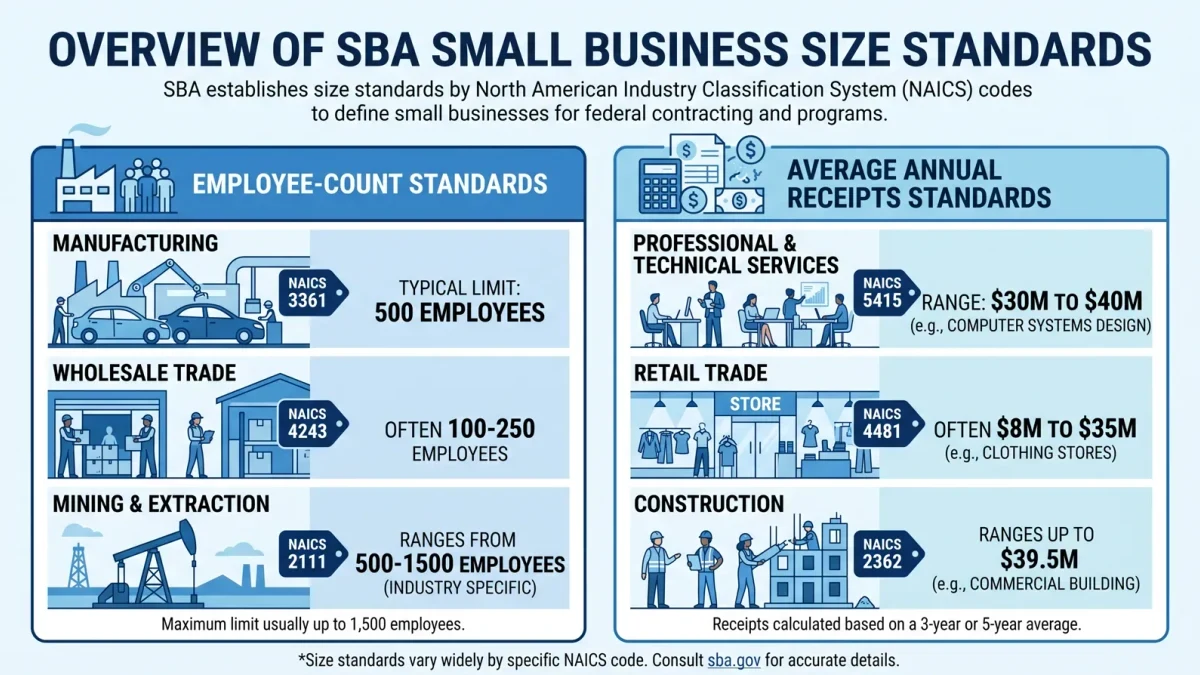
The federal government is the largest buyer in the world, and by law a share of its spending is reserved for small businesses — roughly a quarter of eligible contract dollars in recent fiscal years, per Small Business Administration scorecards. The gate to that set-aside world is the size standard: a maximum number of employees or average annual receipts, set by six-digit NAICS industry code, that defines which businesses count as small. The measurement rules are as important as the numbers. Orer News publishes information, not business or legal advice.
The first practical fact: certification and size determination happen per contract, against the NAICS code the agency assigns to that solicitation — a firm can be small for one contract and other-than-small for another.
How are the standards measured?
Two metrics, chosen by industry. Employee-based standards — average employees over 12 months — apply to manufacturing and some other sectors. Receipts-based standards — average annual receipts over the most recent five fiscal years, including affiliates — apply to most services, retail, and construction. The five-year averaging matters: one strong recent year does not push a firm over the line the way current revenue would, and receipts include everything collected, not profit. Affiliation is the trap: related companies under common control, or firms with heavy dependence on one customer, can have their sizes combined — the SBA's affiliation rules have ended many a small-business eligibility claim.
What does small status actually unlock?
Set-asides: contracts reserved for small businesses when an agency expects competition among them. Socioeconomic programs with additional set-asides: 8(a) for disadvantaged firms, HUBZone for qualified zones, service-disabled-veteran-owned and women-owned programs — each with its own certification, and together the deepest pool of reserved work. Subcontracting: primes on large contracts carry small-business subcontracting plans, making certified small firms attractive teaming partners regardless of prime bidding. And the mentor-protégé programs, which let small firms joint-venture with experienced primes on contracts neither could win alone.
How does a firm get started?
Register in SAM.gov — the single federal vendor database, free — with accurate NAICS codes and size self-certification at the entity level. Validate size through SBA's size-standards tool before bidding, since protesting a rival's size — or being protested — is a normal part of the game with real consequences: a sustained protest on size can cost the award. Certify.SBA.gov is the portal for the socioeconomic programs. Realistic ramp: start as a subcontractor to primes, where past performance is earned without prime-bid risk, then move to small set-aside primes as the past-performance record builds — agencies weigh demonstrated performance heavily, and the classic chicken-and-egg problem is solved exactly this way.
What mistakes disqualify firms?
Stale SAM registrations — renewal is annual, and an expired registration blocks payment, not just bidding. NAICS code mismatches between SAM registration and the solicitation's assigned code. Affiliation left unexamined — common ownership across family businesses or heavy reliance on one prime can combine sizes unexpectedly. And size recertification on long contracts and options: firms grow out of small status mid-contract, and the rules govern when that matters for future options and new bids.
- Size = employees or 5-year average receipts, by NAICS code
- Certify in SAM.gov; check affiliation early
- Subcontract first for past performance, then bid set-asides
- Socioeconomic certifications open deeper reserved pools
Federal work rewards preparation disproportionately: the buying is centralized, the rules are published, and the set-aside pool is real money measured by the SBA's own scorecards. The gate has a number on it — check yours, then register.