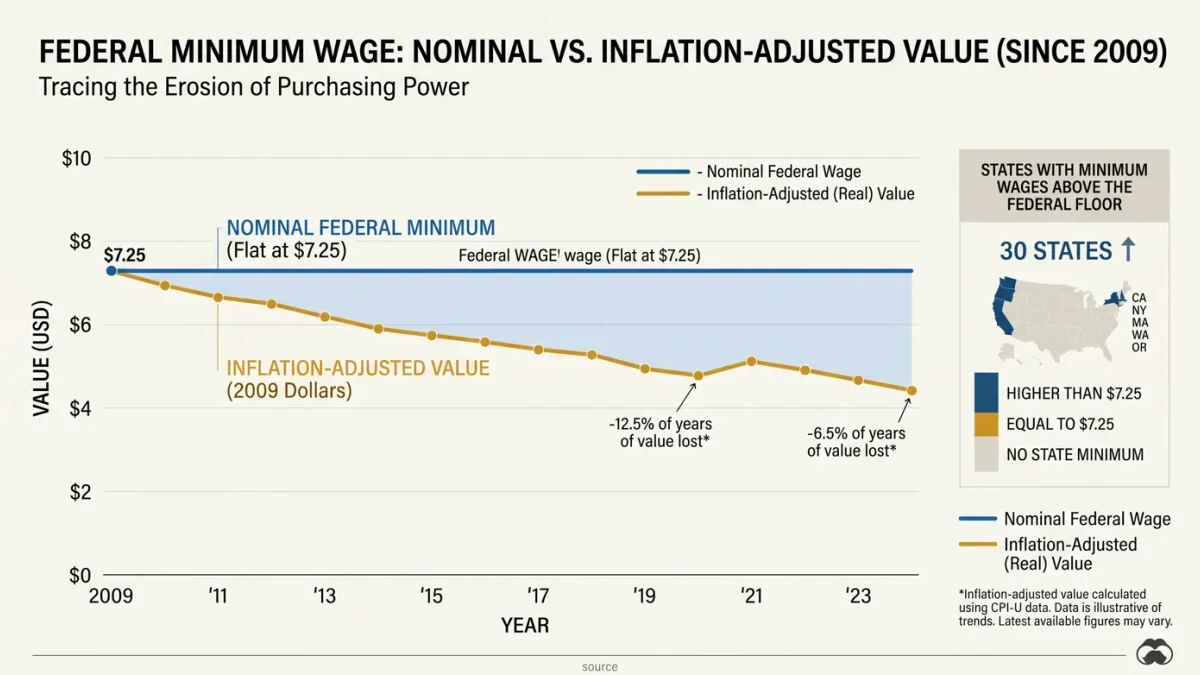
The federal minimum wage has stood at $7.25 an hour since July 2009, but that number is nearly meaningless as a payroll guide: the majority of states set higher floors, many cities and counties set higher ones still, and the Fair Labor Standards Act resolves every conflict the same way — the employee is owed the highest applicable rate. There is no intergovernmental averaging and no exemption for small headcount at the state level in most places. Orer News publishes information, not legal advice.
The complication that catches multi-location employers: the applicable floor can differ by work location, and local ordinances often reach beyond city borders.
How do the layers stack?
Four layers can apply simultaneously: the federal floor; the state floor; county or city ordinances; and industry-specific mandates — airport zones, large-employer thresholds, and scheduled increases written into state law years in advance. The FLSA's supremacy clause pattern works upward: whenever a state or local law requires a higher minimum than the federal act, that law governs. An employer in a city with a $17 ordinance owes $17, not $7.25, not the state rate, and not a blend.
What about tipped employees?
The tip credit is where state and federal law diverge most sharply. Federal law allows a cash wage of $2.13 with a tip credit up to the full minimum, provided tips close the gap — and employers must make up any shortfall. Many states cap or ban the tip credit entirely, requiring the full state minimum in cash before tips; several changed these rules in recent years. Multi-state restaurant groups cannot run one national tip policy; the policy must be rebuilt per jurisdiction.
What traps multi-location employers?
Local ordinances with broader reach than expected — some apply to businesses located in the city, others to employees working hours within it, which affects delivery drivers and hybrid teams. Employees who work in multiple jurisdictions in a pay period: several states apply the highest rate among the locations worked to all hours, by wage-order rule. Scheduled escalators: many state laws legislate annual January increases or CPI-indexed adjustments years ahead, so the rate you checked last summer may have changed. And notice posting: most jurisdictions require current wage notices at the workplace, and stale notices are their own violation independent of pay correctness.
How do you stay current without a compliance department?
A payroll calendar keyed to the real change date — January 1 for most state and local increases, July 1 for a meaningful second wave — with a review each fall of the Department of Labor's state-law tables and the affected jurisdictions' own sites. Build the rates into payroll software as jurisdiction rates rather than a single company rate, so a work-location change re-prices automatically. And audit the gray zones annually: drivers, hybrid staff, minors under state youth-wage rules, and trainee or learner rates, which differ by state and are audited more often than they are checked.
| Layer | Example | Employer owes |
|---|---|---|
| Federal FLSA | $7.25 since 2009 | The floor beneath all floors |
| State | Higher state rates in most states | Replaces federal where higher |
| City/county | Local ordinances, January/July cycles | Replaces state where higher |
| Industry rules | Airport zones, large-employer tiers | Can exceed all of the above |
The rule is one sentence — highest applicable rate wins — and the work is knowing the rates wherever your people actually work. That is a calendar habit, not a legal puzzle.