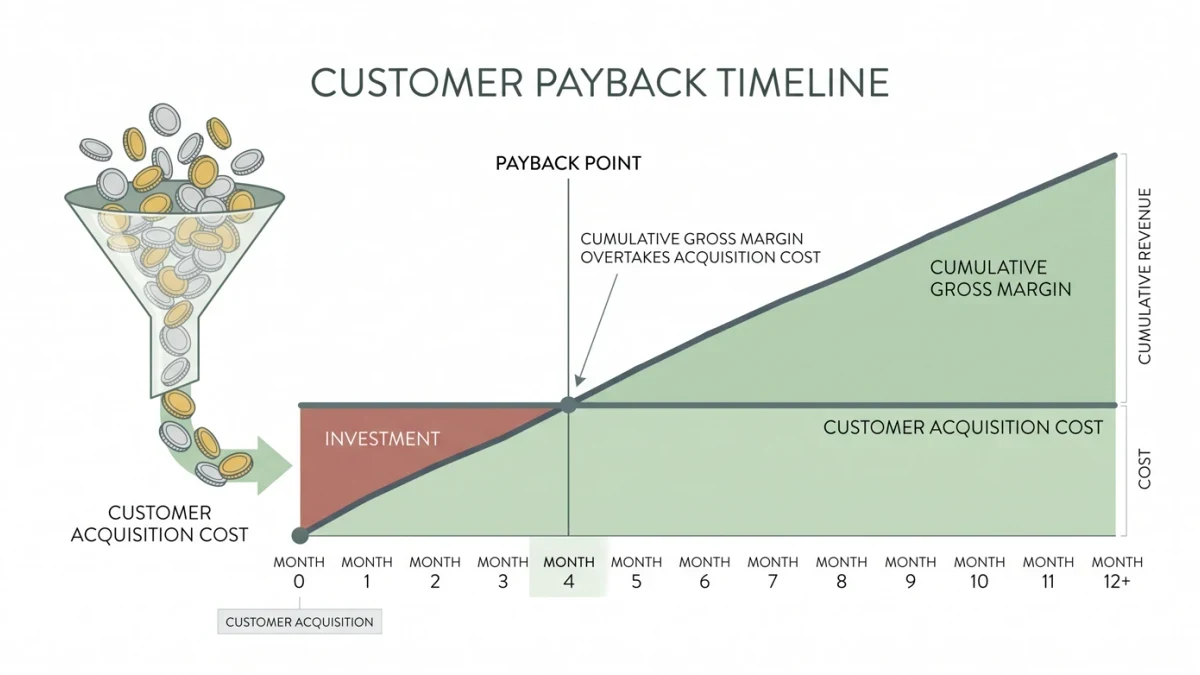
Customer acquisition cost is total sales and marketing spend divided by the number of customers it brought in, in the same period. Lifetime value is the gross profit — revenue minus the cost of serving, not revenue itself — that a customer generates over the relationship. The two numbers together answer the question every growth plan rests on: does buying customers create cash or burn it, and how long until the purchase pays for itself? Orer News publishes information, not financial advice.
Most CAC mistakes are definitional before they are strategic: marketing spend counted without the salesperson's time, LTV computed on revenue instead of margin, totals matched against customers acquired in the wrong month.
How do you compute CAC honestly?
Include everything whose purpose is winning customers: ad spend, agency fees, software for the funnel, sales salaries and commissions, discounts used as incentives, event costs. Divide by new customers acquired in the period that spend influenced — matching spend to the cohort it bought, not to whichever month's signups make the ratio look best. A business spending $9,000 in a quarter — ads, a part-time salesperson, and event fees — to win 60 customers has a $150 CAC. That single number converts vague marketing anxiety into a price you can compare to what a customer is worth.
How is LTV computed — and where does it go wrong?
Gross profit per period times the average customer lifespan in periods, or equivalently gross profit divided by the churn rate. Two errors dominate: using revenue instead of gross margin inflates value by whatever serving the customer costs, and using overstated lifetimes — assuming customers never leave — turns the ratio into fiction. A customer paying $70 a month at 60 percent gross margin who stays a year is worth $504 of gross profit; against the $150 CAC above, the acquisition clears a real return. If the lifespan assumption drops to five months, the same business is buying customers for more than they return.
What ratio should the pair show?
The conventional health check is LTV of roughly three times CAC, with the honest caveat that the ratio alone can flatter a business that waits too long to collect it. That is why the payback period — months of gross margin needed to recover the acquisition cost — is the more operational metric: at $42 of monthly gross margin per customer, a $150 CAC pays back in under four months, meaning growth self-funds almost immediately. A healthy ratio with an 18-month payback is a business that must finance every new customer's purchase with working capital; profitable on paper, cash-hungry in fact.
How do you improve the numbers without cutting growth?
CAC falls three ways: better conversion at the same spend (landing pages, follow-up speed, offer clarity), cheaper mix (doubling down on the channel with the lowest CAC rather than the most impressive one), and referrals, which convert warm prospects at near-zero incremental cost. LTV rises two ways: retention — the cheapest growth that exists, since a churned customer must be re-bought at full CAC — and margin expansion through upsells or reduced service cost. The compounding effect is why small retention improvements move LTV more than large marketing budget increases move CAC.
| Metric | Formula | Healthy sign |
|---|---|---|
| CAC | All acquisition spend ÷ new customers | Stable or falling at scale |
| LTV | Gross profit × lifespan | Computed on margin, not revenue |
| LTV:CAC | Ratio | Roughly 3:1 |
| Payback | CAC ÷ monthly gross margin | Under 12 months; under 6 strong |
Every growth decision — raise ad budget, hire a salesperson, discount the first order — is a bet on these four numbers. Computing them quarterly turns those bets from temperament into arithmetic.