A business plan written for investors is not a document; it is an argument with exhibits. The Small Business Administration's own planning guidance frames the plan as a tool to be tested and revised, not a term paper — and experienced readers treat it that way, going straight to the sections where founders most often fool themselves. Writing for how it will actually be read is not cynicism; it is efficiency. Orer News publishes information, not investment advice.
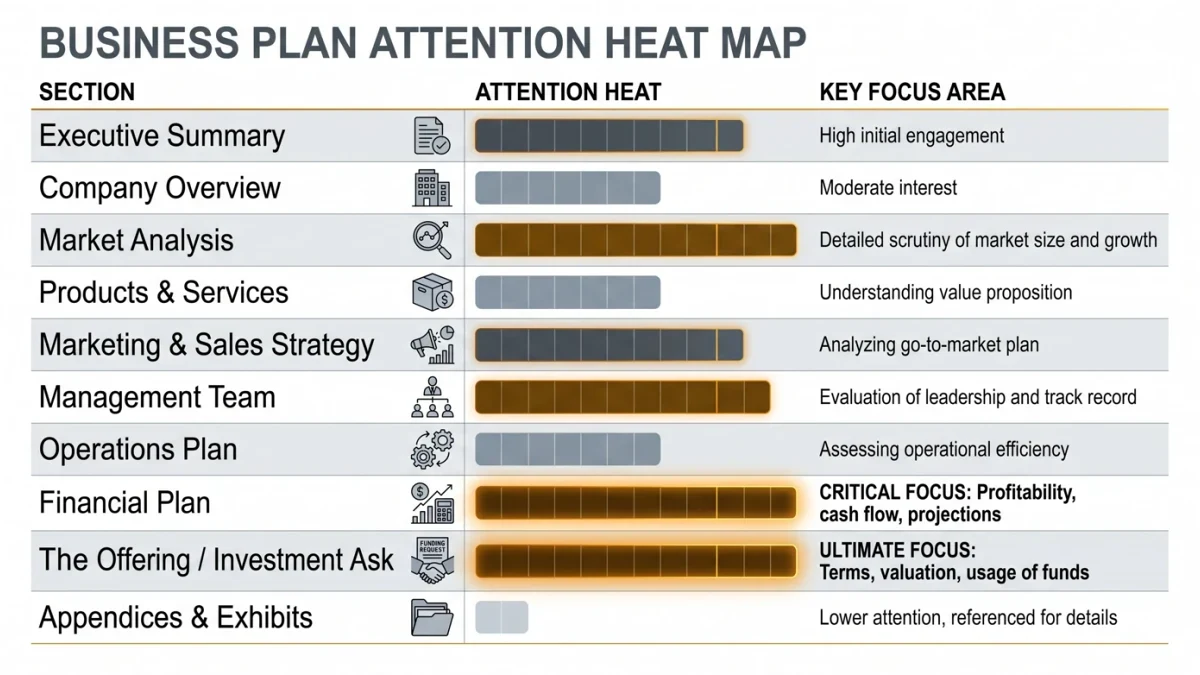
In practice, three parts carry the decision: the numbers, the ask, and the operational evidence. Everything else is context for those three.
Why the unit economics page comes first?
Sophisticated readers flip to the model before the narrative: customer acquisition cost against lifetime value, gross margin per unit, payback period on acquisition spend. These three numbers answer the question the whole document exists for — does the machine make money per customer, and how fast does the machine pay for its own growth? A plan with beautiful prose and mushy unit economics is a marketing plan. A plan with ugly prose and clean unit economics gets meetings.
What does the ask need to contain?
A specific amount, a specific use of funds tied to specific milestones, and a specific definition of what those milestones buy — typically 18 to 24 months of runway to a state that either funds itself or clearly justifies the next round. Vague asks signal vague thinking. The use of funds should map to the operating plan line by line: this hire, this inventory, this campaign, each with an expected return stated in the plan's own projections.
Which operational evidence gets read closely?
The sections readers interrogate hardest are the ones where founders most often confuse hope with fact. Market size claims — the classic hockey stick of total addressable market — get discounted heavily; the believable version is a bottom-up count of reachable customers times realistic pricing. Competitive analysis read as "nobody else does this" gets read as "the founder has not shopped lately"; the credible version names substitutes and states plainly why customers would switch. And team sections matter less as biography than as fit: which member has done this specific hard thing before.
How long should the plan be?
As short as the argument allows — commonly 15 to 25 pages plus appendices, with a one-page summary in front and the detailed financial model behind. The model itself deserves more rigor than the prose: monthly for two years, annual beyond, with assumptions stated separately so a reader can flex them. A reader who disagrees with your growth rate should be able to change one cell and watch the outcome move — that is what makes a model an instrument rather than a decoration.
What about plans for lenders rather than investors?
Bank readers weight different pages: collateral, personal investment, cash-flow coverage of debt service, and the owner's credit history dominate. A lender wants to be repaid from cash flow; an equity investor wants a return from growth — the same business gets two different plans, or at least two different emphases, and sending the equity version to a bank wastes both sides' time.
| Section | What the reader looks for |
|---|---|
| Unit economics | CAC vs LTV, margin, payback period |
| The ask | Amount, use of funds, milestones bought |
| Market size | Bottom-up count, not top-down percentage |
| Competition | Named substitutes and switch reasons |
| Financial model | Monthly detail, separated assumptions |
Write the plan to survive its least charitable reader. The pages that convince are the ones with numbers you can defend from a cell the reader is allowed to change.