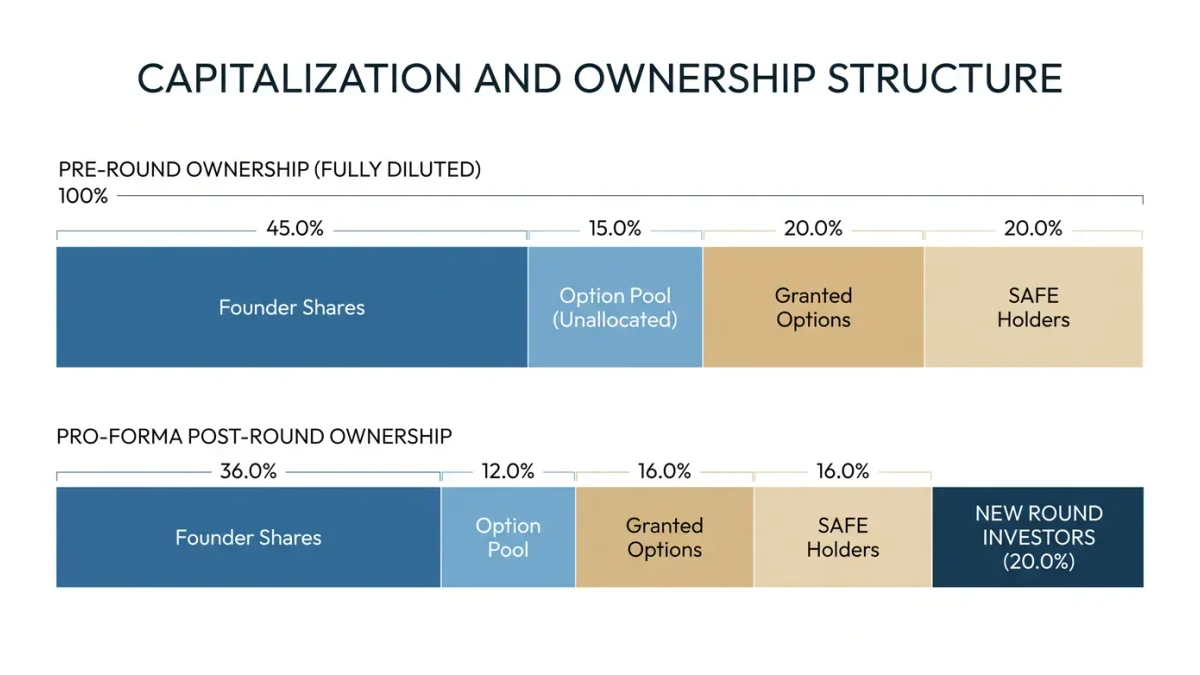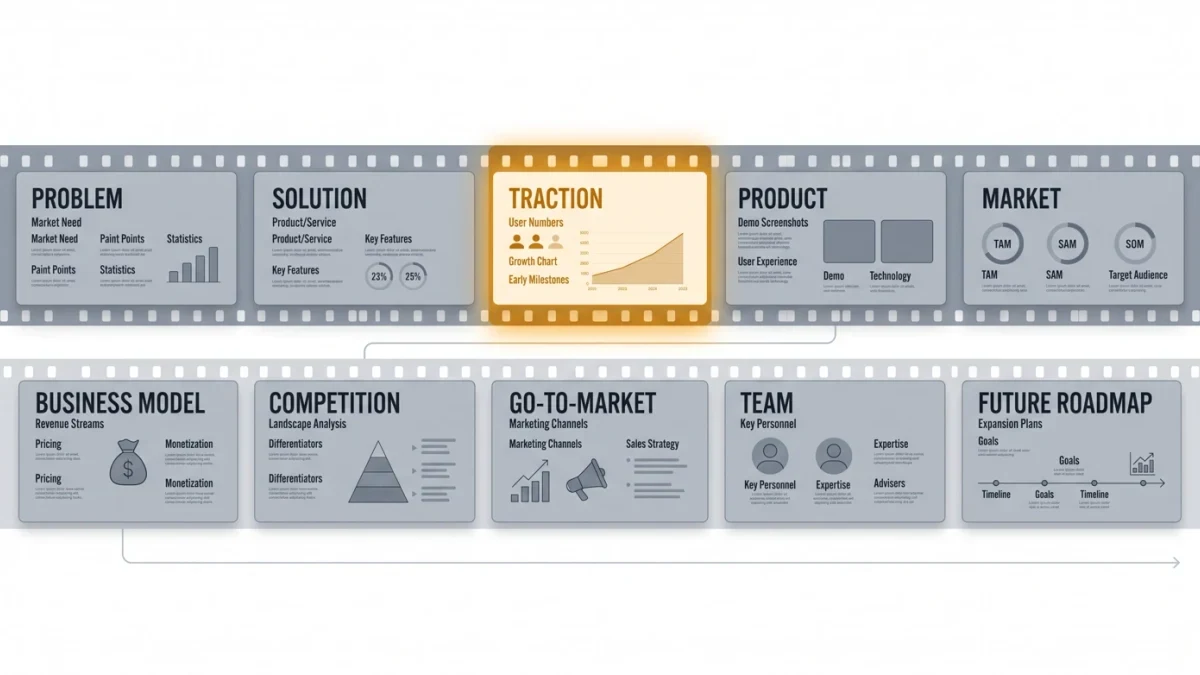
A seed deck is a screening document, not a biography. Investors reading cold make a provisional pass-or-pass decision within the first few slides, and everything after that is confirmation. The deck's job is therefore ordering: the three slides that decide whether the rest gets read — problem, traction, and the ask — belong up front, and the slides founders love most, the technology and the vision, come later. Orer News publishes information, not investment advice.
Decks run commonly 10 to 15 slides, and the classic sequence has survived because it matches how strangers evaluate claims.
What goes on the first three slides?
Slide one states what you do in one plain sentence — the category, the customer, and the mechanism. Slide two is the problem, made specific and expensive: who has it, what it costs them today, and why current alternatives fail. Slide three is traction, the single most persuasive slide at seed stage: revenue or growth图表 — paying customers, expansion, retention — with dates. A deck with real traction on slide three gets its technology read with sympathy; a deck without it gets its technology read as risk.
How much market sizing survives scrutiny?
Top-down totals — "a share of a $50 billion market" — get discounted to zero by experienced readers, because everyone writes them. The credible version is bottom-up: how many reachable customers exist in the segments you can actually sell to now, at your actual pricing, and what the adjacent expansion looks like. A modest, defensible bottom-up count beats an impressive percentage of a giant number.
What makes the ask slide work?
The ask slide carries three numbers: how much you are raising, what it buys in milestones — headcount, product, go-to-market — and how long it lasts, typically 18 to 24 months of runway to a state that either funds itself or clearly sets up the next round. Investors read the use of funds as a test of operating judgment: an ask padded with premature hires or vague "growth spend" reads worse than a smaller ask mapped precisely to what the next 18 months require.
Which slides do founders overweight?
Technology and vision, reliably. The tech slide should state what the product does and why it is hard to copy in one visual, not a stack diagram. The vision slide belongs at the end, as context for scale, not at the start as atmosphere. Similarly overweighted is the competitive slide listing logos without a statement of why customers choose you — readers want the axis you win on, not the map. Team slides matter, but as fit-for-this-specific-problem evidence rather than credential lists.
What design rules actually matter?
Legibility at a glance: one idea per slide, numbers instead of adjectives, and dated claims — "$28,000 monthly recurring revenue as of June 2026" rather than "growing fast." Send a PDF that reads without narration, because most first reads happen without you. And rehearse the numbers themselves: the fastest credibility loss in a pitch meeting is a founder who cannot decompose their own traction or unit economics when asked.
- One plain sentence for what you do
- Traction with dates on slide three
- Bottom-up market count, not top-down share
- Ask = amount, milestones, runway months
The deck is not the pitch; it is the permission to have the pitch. Optimize it for the three-minute triage, and let the meeting do the persuading.