Refinancing trades an old loan for a new one, and it pays when the trade's arithmetic does: interest saved over the remaining life, minus the costs of doing the deal, adjusted for whatever the new term changes. Owners routinely get two of the three pieces wrong — celebrating a lower payment that a longer term manufactured, or ignoring fees that consume the first year's savings. The honest computation is a napkin's worth of work. Orer News publishes information, not financial advice.
Three distinct purchases hide inside the word "refinance": a lower rate on the same schedule, a lower payment via a longer schedule, and a cash-out restructuring. Price each separately.
What is the lower-rate trade worth?
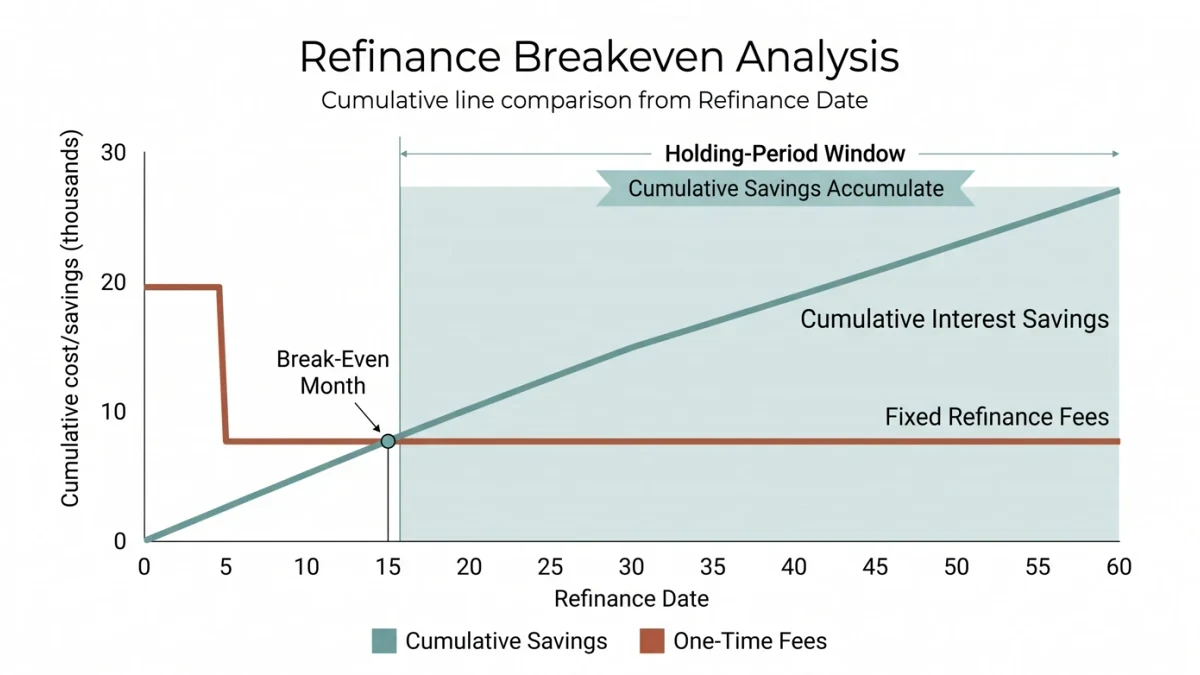
Take the remaining balance, the rate difference, and the remaining term. A $200,000 balance with four years left, refinanced from 9 percent to 7 percent, saves roughly $4,000 a year in interest — about $14,000 over the life, before costs. Against that: origination fees — commonly 1 to 3 percent at banks, more at online lenders — appraisal and legal costs on secured deals, and any prepayment penalty on the old loan. If total costs run $6,000, the break-even sits at eighteen months; a borrower planning to sell or close within that window loses money refinancing. The rule: savings must repay the costs well inside the expected holding period.
What does term extension really do?
Extending a term lowers the payment and raises total interest — a fact presentation order obscures. Four remaining years stretched to seven at the same rate cuts the monthly payment meaningfully while adding years of interest on a balance that would otherwise be shrinking. That is sometimes the right purchase: a business in a genuine cash squeeze that needs payment relief to survive a slow season is buying liquidity, and knowing the total-cost premium is part of buying it responsibly. But a term extension dressed as a rate win — the common sales pattern — is the trap: compare total interest over the whole new term against the old loan's remaining interest, not the two monthly payments side by side.
When is the timing right?
Rate environment: refinancing into lower benchmarks is the obvious window, and the Treasury curve tells you in advance which way fixed quotes have moved. Credit improvement: a business with two more years of clean financials, better DSCR, or an established banking relationship often qualifies for pricing it could not before — a reason to requote even in a flat rate environment. Consolidation logic: several small high-rate balances folded into one term loan can cut blended cost and simplify payments, though maxed revolving balances should be consolidated only after the structural gap that filled them has closed. And watch existing loan terms before anything: prepayment penalties and lockout periods can erase a marginal deal.
What does SBA refinancing offer?
SBA 7(a) refinancing can replace conventional or higher-cost debt for qualifying firms, often at longer terms than conventional lenders offer — which lowers payments genuinely — with the standard SBA guarantee fee structure. The eligibility rules are specific, including that the new loan provides a tangible benefit, so the starting point is the published program terms and a participating lender's worksheet rather than a brochure's promise.
- Compute life-of-loan savings, not payment deltas
- Add all fees and prepayment penalties to the cost side
- Break-even must land inside your expected holding period
- Consolidate only after the structural gap has closed
Refinancing is a trade with visible prices on both sides. Run the three computations — rate savings, term cost, total fees — and the decision stops being a sales conversation and becomes what it should have been all along: arithmetic.