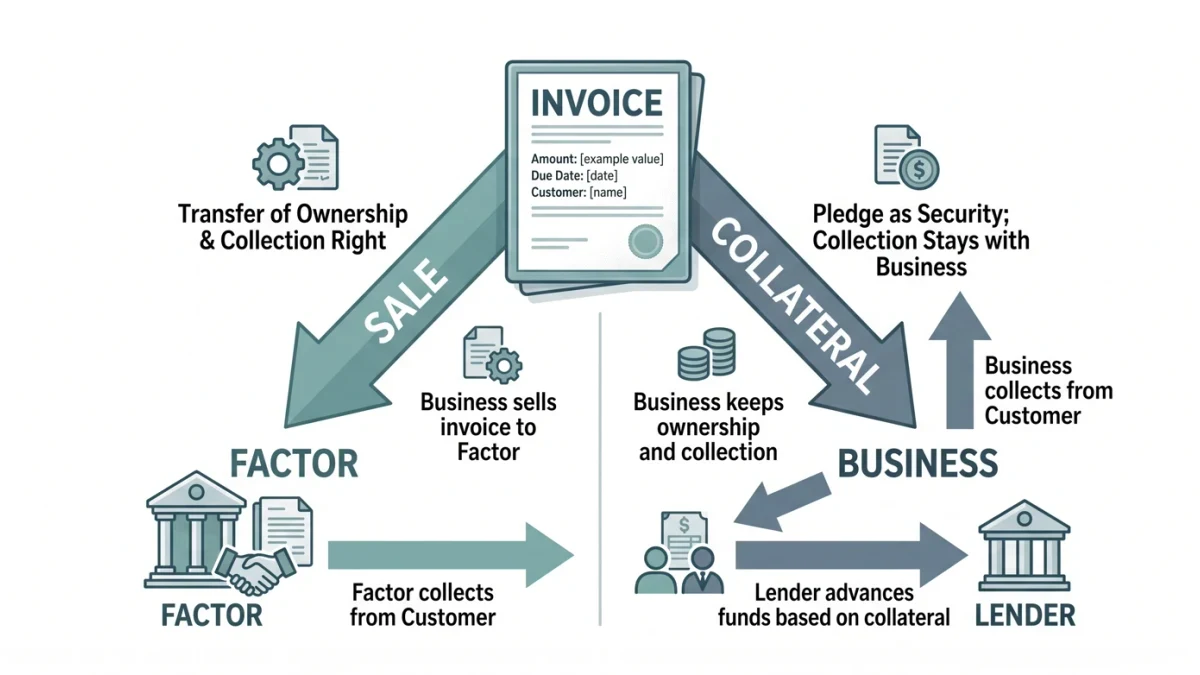
Both products turn unpaid invoices into cash now, and both are priced on the credit quality of your customers rather than yours — which is why firms with thin credit but strong clients use them. But they are different transactions. Factoring is a sale: you sell the invoice to a factor at a discount and the factor collects from your customer. Invoice financing is a loan: you borrow against the invoice as collateral and you still collect. The distinction drives fees, customer experience, and risk.
The common thread is cost: both run meaningfully more expensive than a bank line, per dollar of cash advanced, because they are fast, unsecured-by-you, and underwritten in days.
How does factoring work?
You invoice the customer and send the invoice to the factor, which advances typically 70 to 90 percent of face value, holding the rest as a reserve. When the customer pays, the factor releases the reserve minus its discount fee. In non-recourse factoring, the factor bears the customer's nonpayment; in recourse factoring — cheaper — you buy back the invoice if the customer fails, so the credit risk stays yours. The visible consequence: your customers receive collection notices from a finance company, which communicates to them exactly how your working capital is arranged. In some industries — trucking, staffing, apparel — factoring is common enough that nobody blinks; elsewhere it can read as a distress signal.
How does invoice financing work?
A lender advances against a pool of your outstanding invoices — you keep collecting from customers, repay the advance as invoices settle, and pay interest on the drawn balance, sometimes with platform fees. Because you remain the collector, your customers see nothing, and because the invoices are collateral rather than sold, repayment flexibility is higher. The trade: credit risk on unpaid invoices stays with you in nearly all structures, and the lender can re-advance or demand repayment based on the pool's aging — invoices past 90 days usually stop counting as collateral, a rule that bites exactly when a customer stretches.
How do the costs compare?
Factoring pricing is quoted as a factoring rate per period — commonly in the low single digits per 30 days, but compounding on older invoices: an invoice aging 90 days at 2 percent per 30 days costs three times the rate of one paid on time. Invoice financing is quoted as an annualized rate on the drawn amount plus fees, closer to credit-line pricing. The honest comparison annualizes both over the actual days outstanding and adds fees, reserves, and minimums — factoring contracts often carry monthly minimum volumes and termination penalties that raise the effective cost for seasonal users.
Which fits which business?
Factoring suits firms whose customers are large, credit-strong, and slow — staffing agencies invoicing Fortune 500s, truckers invoicing brokers — and industries where factoring is normalized. Invoice financing suits firms wanting invisible financing and steady collections, with the discipline to manage the aging pool. Neither suits a firm whose real problem is unprofitable unit economics: accelerating receivables at double-digit effective cost while losing money per sale deepens the hole with interest. The diagnostic before either: measure the cash conversion cycle, price the gap's true cost, and compare against a conventional credit line — which is slower to arrange but usually a third of the price.
- Factoring = sale; recourse returns risk to you
- Invoice financing = borrowing; customers see nothing
- Annualize fees over actual days outstanding before comparing
- Fix the collection cycle or the product buys weeks at usurious rates
Receivables products are bridge financing priced for speed. They are excellent at converting a confirmed sale into cash this week and terrible as a permanent cost structure — the difference between a tool and a habit is whether the underlying invoices keep aging.