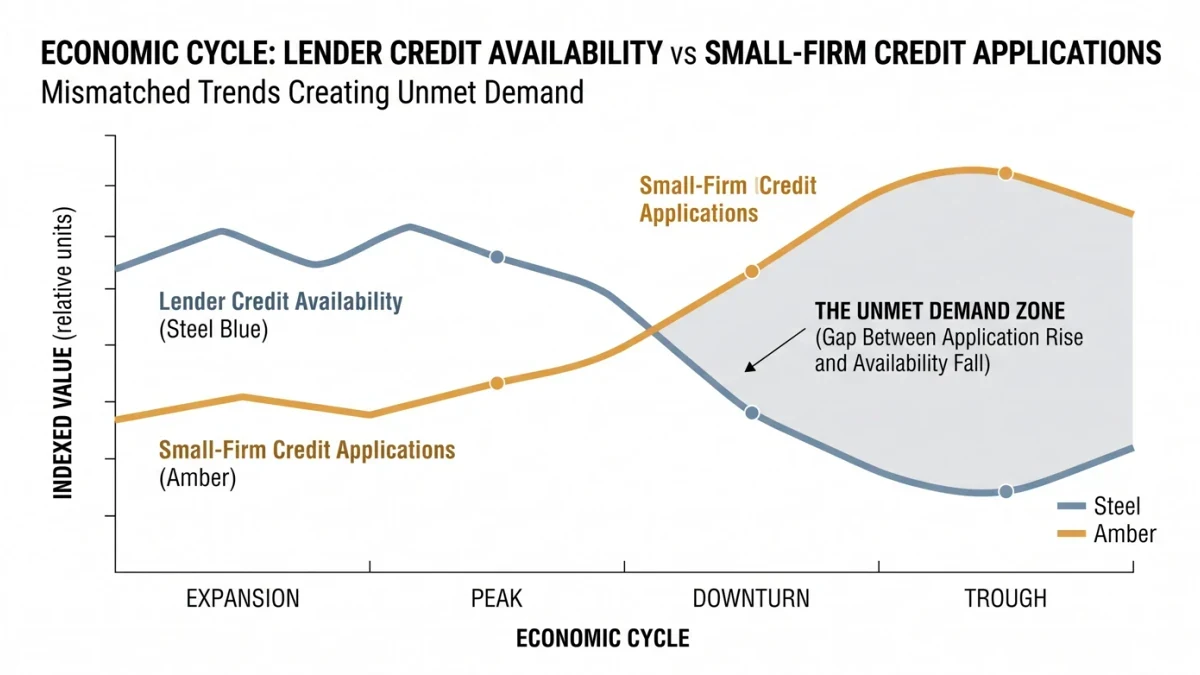
The most expensive time to apply for credit is the moment you need it. Lenders underwrite cash flow, and a business in a downturn presents exactly the financials that decline applications: shrinking revenue, weakening coverage, strained receivables. The undrawn line of credit is the instrument that solves the timing problem — borrowing capacity arranged while financials are strong, held in reserve, and drawn only when the gap arrives. Federal Reserve survey work has documented repeatedly that credit availability tightens for small firms in downturns precisely when applications rise, which makes the counter-cyclical value of a standby line structural, not theoretical. Orer News publishes information, not financial advice.
The line exists in two states, and both cost money — understanding both costs is the whole decision.
What does a standby line cost while unused?
Typically an annual fee, sometimes a small unused-line fee on larger facilities, and the administrative burden of keeping the relationship current — financials updated, covenants reported. What it does not cost is interest, because interest accrues only on drawn balances. Against those modest fees, the line is an option: the right, not the obligation, to borrow at a pre-agreed formula when conditions are worst — and options are cheapest precisely before the volatility they insure against arrives.
Why can't you just apply when trouble starts?
Because underwriting reads trouble as risk. The DSCR the lender computes on declining revenue produces either a decline, a smaller line, or a materially higher price — the same business, a different quarter. There is also the institutional layer: in credit crunches, banks cut exposure across portfolios, reprice lines, and reduce commitments — sometimes exercising reduction or termination rights written into the agreement. A line set up in strong times carries those same clauses, but it enters the downturn already documented, already performing, and already at the front of the queue for renewal.
How large should the standby be?
Scale it to the reserve math: the months of essential expenses the business should hold in cash, minus what it actually holds, bridged at plausible draw rates. A business targeting three months of essential costs that holds one month in cash has a two-month gap — the line should cover it with room for the seasonal component of working capital. Overlining is its own error: larger lines carry larger fees, and unused capacity tempts exactly the drawn-line-as-income habit that converts a liquidity tool into structural debt.
How is a standby line structured?
As a revolving facility with a multi-year term, priced floating — typically off prime or SOFR plus a spread reflecting your credit — with a commitment the lender must honor through the term. The features that matter at signing: the commitment period's length, any annual clean-up expectation (some lenders want the line fully repaid for a period each year — worth negotiating away for a genuine standby), material-adverse-change clauses, and reporting covenants you can actually meet in a bad quarter, because a tripped covenant can freeze the line at the worst moment. Collateral and guarantees follow normal small-business practice; the SBA's CAPLines programs address seasonal and working-capital revolving needs for qualifying firms.
What discipline keeps it a tool?
Written draw rules: defined triggers — a revenue threshold, a contract delay, a seasonal buy — and a repayment expectation attached to each. Draws matched to identified inflows, not general top-ups. And the line reviewed annually alongside the cash reserve: together they are the business's liquidity position, and one without the other is half a plan. Cash you hold is yours; the line is the bank's promise; businesses that want resilience hold some of each.
- Apply on strong financials — approval is a function of the quarter
- Expect an annual fee; interest accrues only on draws
- Size to the gap between target and actual cash reserve
- Write the draw triggers down before the downturn
Credit is granted in calm markets and rationed in stressed ones. The standby line is how a small business buys its calm-market terms in advance — an insurance policy whose premium is an annual fee and whose claim process is a draw request you hope never to file.