The qualified business income deduction — Section 199A — lets owners of pass-through businesses (sole proprietorships, partnerships, S corporations, LLCs taxed as any of these) deduct up to 20 percent of qualified business income before applying ordinary tax rates. It is a rare tax benefit that arrives as a deduction on the owner's personal return with no entity-level computation, and its rules were reshaped by 2025 legislation, making current-law verification with a preparer a requirement rather than a formality. Orer News publishes information, not tax advice.
The deduction has always had two gates — income thresholds and business type — and both moved with recent legislation.
How does the basic deduction work?
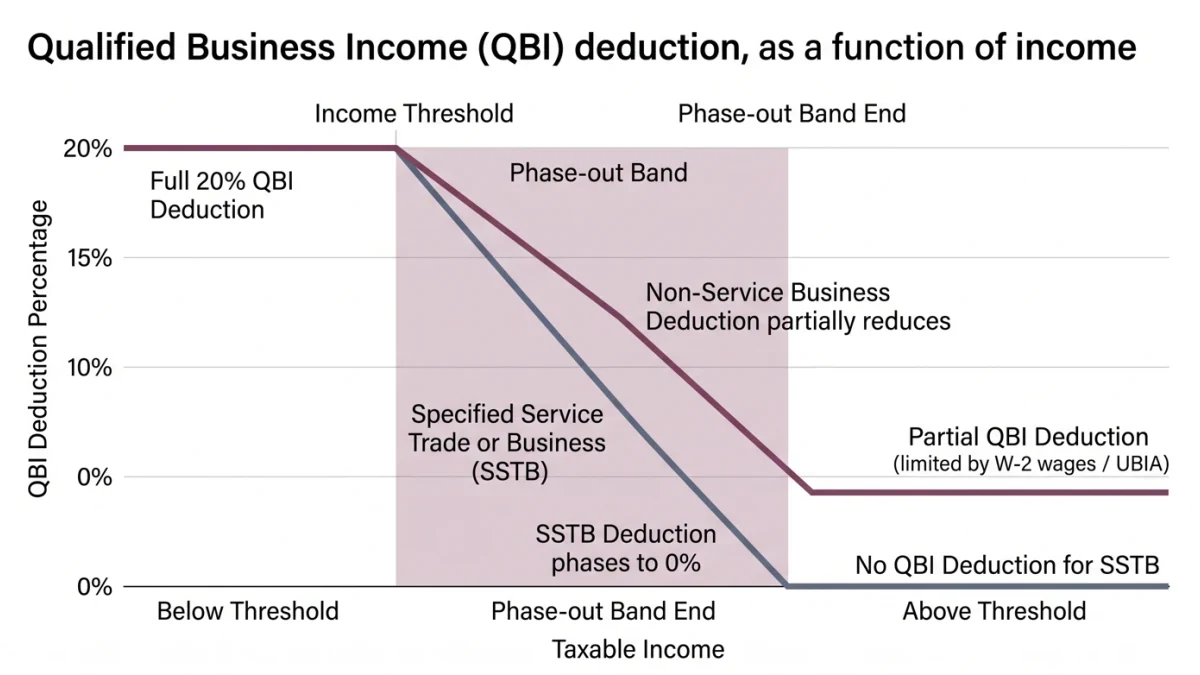
Qualified business income is the ordinary income of the pass-through: profit shown on Schedule C, K-1 boxes for ordinary income, minus capital items. The deduction is the lesser of 20 percent of QBI or 20 percent of taxable income minus net capital gains. Below the income thresholds, that is the whole computation — 20 percent off the top of business profit. Above them, the gates arrive: specified service trades or businesses (SSTBs) lose the deduction as income phases through a band, and non-service businesses face limits tied to W-2 wages paid and the unadjusted basis of qualified property.
What are the thresholds and the service trap?
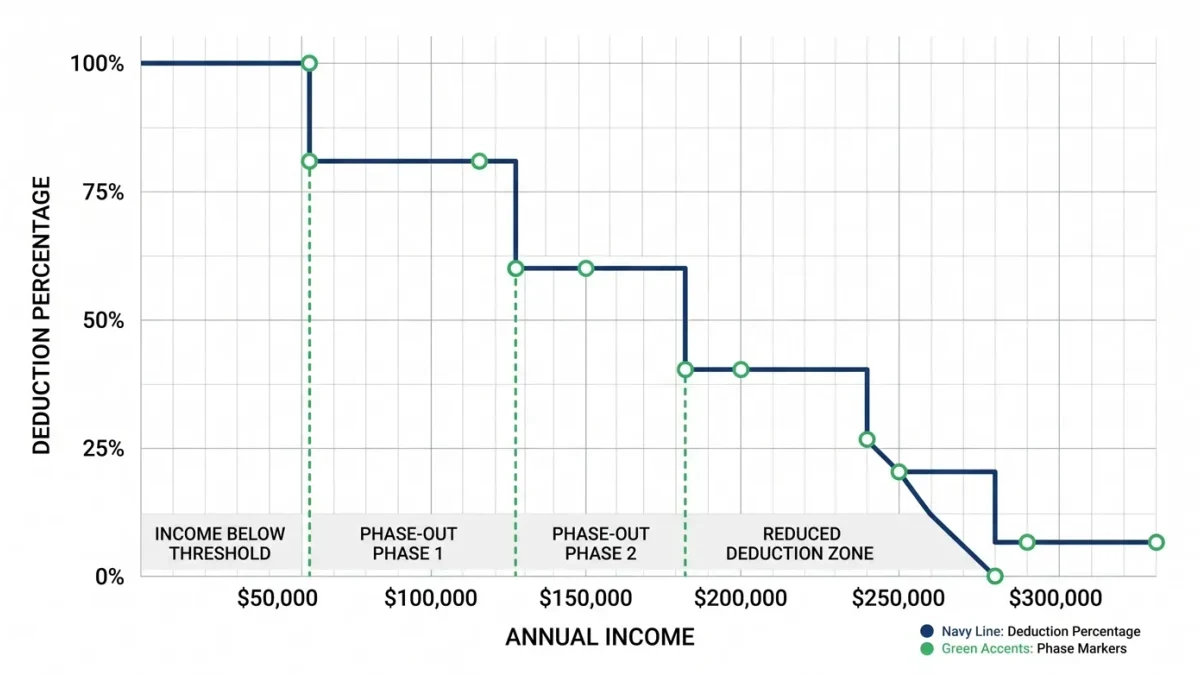
For 2025, the phase-out bands began around $197,300 single and $394,600 married filing jointly, per IRS inflation adjustments. SSTBs — health, law, accounting, consulting, financial services, athletics, and businesses where the principal asset is the reputation or skill of employees or owners — are fully deductible below the band and fully disallowed above it, phasing in between. A non-service business above the thresholds instead computes a wage-and-property limit: the deduction cannot exceed the greater of 50 percent of W-2 wages paid or 25 percent of wages plus 2.5 percent of qualifying property basis. The practical consequence: above the bands, labor-heavy service firms lose QBI, while capital- or payroll-heavy businesses keep it.
What changed in the legislation of 2025?
The deduction had been scheduled to expire after 2025 under prior law. The 2025 tax act made it permanent — and modified it: for tax years after 2025, the phase-out for SSTBs was tightened from a 20-percentage-point band to a sharper 15-point phase-out beginning at roughly $400,000 married, and the wage-limit band similarly compressed, with the amounts indexed thereafter. The structural takeaway survives the details: below the thresholds, everyone qualifies; above them, service businesses bear the squeeze, and entity or compensation planning moves from optional to consequential. Current-year numbers belong to your preparer's software; the strategy belongs to the year before the income arrives.
What planning levers exist?
For S corporation owners, the salary-distributions split interacts with QBI: wages do not count as QBI, distributions of qualified profit do — so an unreasonably low salary raises QBI, and the reasonable-compensation doctrine bounds the game. For SSTB owners near the band, deferring income or accelerating deductions to stay below a threshold in a given year is a standard, legitimate year-end strategy. For non-SSTB firms above thresholds, the W-2 wage limit rewards payroll — hiring and timing bonus payments can preserve deduction room. And separating a qualifying component from a service business — the product arm from the consulting arm — has succeeded where the separation is real and failed where it was paper; the anti-abuse rules here are well-developed.
- 20% of qualified business income, deducted on the personal return
- Below thresholds: near-automatic; above: service businesses phase out
- Non-service firms above limits: deduction tracks W-2 wages and property
- 2025 law made 199A permanent and tightened the bands — verify annually
QBI is one of the largest standing deductions available to small-business owners, and its gates are all functions of income and business type known in advance. That makes it a planning number, not an April surprise — the owners who treat it that way keep the full 20 percent.