The two workhorse retirement plans for self-employed owners — the SEP-IRA and the individual (solo) 401(k) — share an annual contribution ceiling of about $70,000 for 2025, per IRS limits, but reach it by different roads and differ in everything else that matters: who must be covered, what it costs to run, and how much a moderate earner can actually shelter. Choosing wrong is rarely catastrophic; choosing deliberately is worth real money over a career. Orer News publishes information, not investment, tax, or retirement advice.
The comparison below reflects published IRS limits for 2025; verify current-year figures before contributing.
How does the SEP-IRA work?
A SEP is simplicity itself: a one-page adoption agreement, no annual filing, contributions up to 25 percent of compensation — roughly 20 percent of net self-employment earnings after the deduction for half of self-employment tax — capped at $70,000 for 2025. Setup is free through most brokerages, and contributions are flexible: you decide each year how much to put in, which suits volatile income. The catch is employee coverage: any employee meeting modest service and age thresholds must receive the same contribution percentage you give yourself — the SEP's low cost is real only for true solo operators or firms whose profit margins happily fund across-the-board contributions.
How does the Solo 401(k) work?
The individual 401(k) covers only the owner and a spouse — employees, even part-timers meeting thresholds, generally disqualify the design, sending you to a traditional plan with real administration. In exchange for setup and, above $250,000 of assets, an annual Form 5500-EZ filing, the solo 401(k) offers two contribution channels: employee deferrals up to $23,500 for 2025 — plus catch-up contributions from age 50, and a special catch-up band from ages 60 to 63 under recent legislation — and employer profit-sharing of roughly 20 percent of net earnings. The practical consequence is the headline advantage: at modest income, the deferral channel lets you shelter far more than a SEP's percentage alone.
What does the arithmetic show?
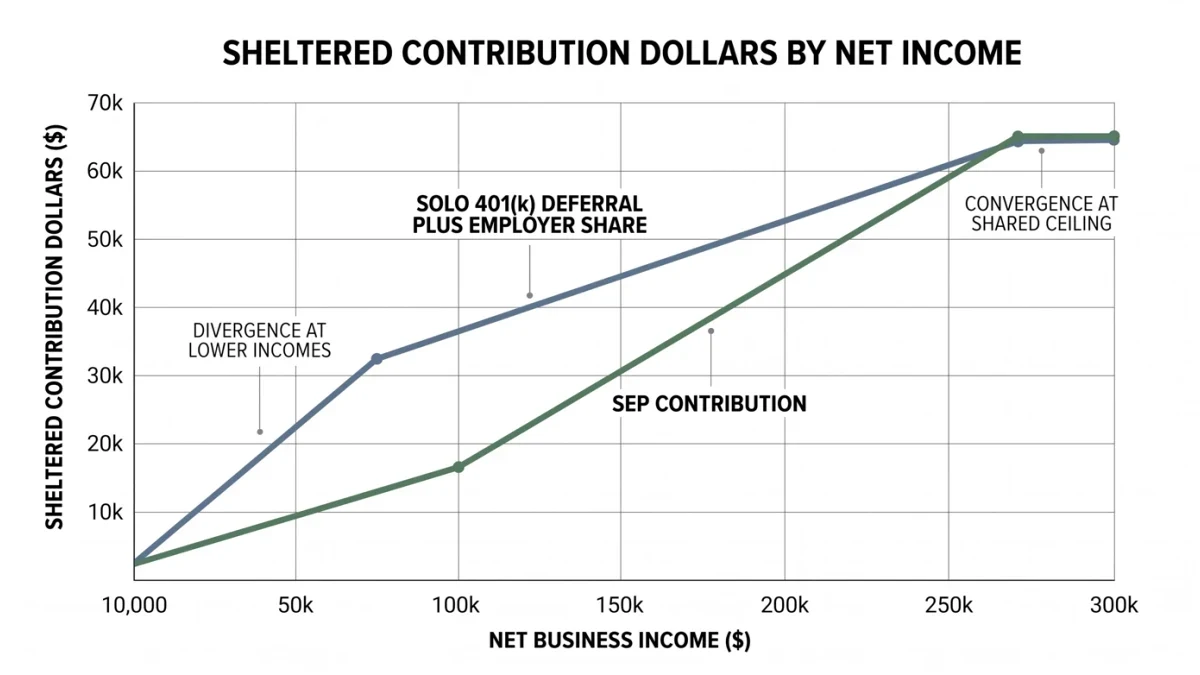
At $100,000 of net self-employment earnings, a SEP caps around $18,000 to $20,000 — roughly 20 percent. A solo 401(k) allows the same employer slice plus $23,500 of deferral, limited only by the earnings and the overall $70,000 ceiling — so the same owner can shelter $40,000-plus. At high income, both plans hit the same ceiling and the choice moves to other features. That crossover is the decision's center: below roughly the deferral-plus-20-percent intersection, the solo 401(k) shelters meaningfully more; above it, they tie.
What features tip it after that?
The solo 401(k) permits Roth employee deferrals — after-tax contributions with tax-free growth — which the SEP does not, and permits loans against the balance, which SEP-IRAs effectively do not. The SEP permits earlier, easier setup — even for the prior tax year by the filing deadline with an extension, a genuine rescue feature for owners who discover retirement planning in April. And SEP money remains IRA money for creditor-protection and withdrawal-rule purposes, while 401(k) assets have their own — generally stronger — federal creditor shield, a consideration in risk-exposed professions.
| Feature | SEP-IRA | Solo 401(k) |
|---|---|---|
| 2025 ceiling | ~$70,000 | ~$70,000 |
| Low-income shelter | ~20% of earnings | Deferral + 20% — much more |
| Employees | Must match your percentage | None allowed (spouse excepted) |
| Roth option | No | Yes, on deferrals |
| Admin | One page, no filing | Setup; 5500-EZ above $250k |
The one-sentence version: no employees and income under the crossover — solo 401(k); employees, simplicity, or an April rescue — SEP. Either way, the ceiling is generous; the only unaffordable plan is the one not opened.