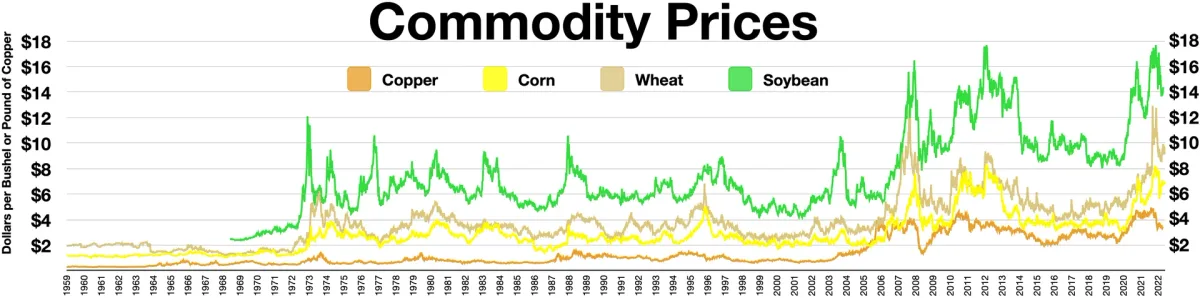
Commodity volatility reaches a small business long before any economist's recession probability does: copper in the equipment you buy, resin in packaging, grain in food inputs, lumber in construction. The S&P 500's swings get the coverage, but the volatility that changes your margin lives in commodity futures — and the businesses that weather it are not the ones that predicted it, but the ones whose contracts already say who bears the move. Orer News publishes information, not financial advice, and makes no market forecasts.
The design problem is simple: over what horizon is your price fixed, and what happens when the market leaves that horizon?
What do volatile input markets actually do to contracts?
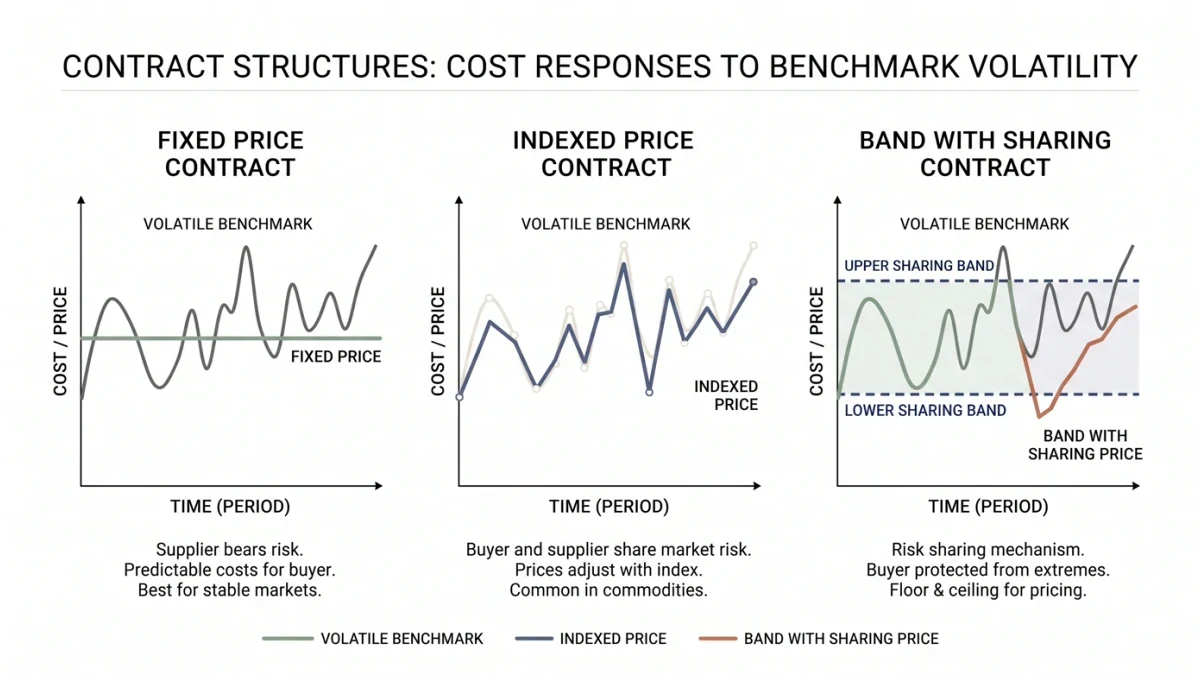
Unfixed risk migrates to whichever party dislikes it least — usually the supplier, who then prices a premium for carrying it or simply refuses long commitments. In calm markets, fixed-price annual agreements feel free; in volatile ones, suppliers quietly add cushion, cap quantities, or reprice mid-term with escape clauses you did not read. The counterintuitive result: in genuinely volatile input markets, a fixed price can be the expensive option, because you are paying an insurance premium inside it. The alternative is not guessing — it is structuring.
What structures spread the risk fairly?
Three standard patterns. Indexed pricing: the contract price floats on a published benchmark — an exchange settlement, a government index, a listed spot average — so both sides ride the same public number and no one is betting against the other. Bands with sharing: price floats within, say, plus or minus 5 percent of a reference, and moves beyond the band are shared by an agreed formula; this preserves stability while capping extremes. Collars and hedges: for exchange-traded inputs, a futures position or an options collar can bound the price the business ultimately pays; businesses too small to trade directly can buy from suppliers willing to sell fixed-forward windows — effectively outsourcing the hedge.
What should you negotiate for specifically?
Length asymmetry is the hidden trap: a sales contract that fixes your output price for a year against input costs that float monthly is a short position in every input you use, held unknowingly. Match horizons — float your price where inputs float, or lock inputs where prices are locked. Volume flexibility clauses matter more in volatile times: the right to take 80 to 120 percent of forecast at the agreed formula keeps you from choosing between breaking the contract and warehousing cash as inventory. And escape or re-opener clauses that trigger on benchmark moves beyond a band are more honest than the improvised breach that replaces them when no clause exists.
How do you manage inventory under volatility?
Volatility tempts two opposite errors: panic forward-buying at a local high, and running lean into a rising market. The structured middle is buying on a schedule with formula pricing regardless of level — dollar-cost averaging for procurement — combined with slightly larger safety stock only for inputs with long lead times and concentrated supply. Track the ratio of inventory value to sales as you do it, so the hedge does not quietly become a speculation.
- Fix the horizon match: floating inputs need floating prices
- Index, band, or collar — pick a structure, not a guess
- Volume flexibility of ±20% beats breach disputes
- Buy on schedule; hedge only what you can identify
Volatility is not a forecast category; it is a permanent feature of input markets. The businesses that treat it as a contract-design problem keep their margins when the charts get ugly — and keep their suppliers, who prefer a shared formula to an argument.