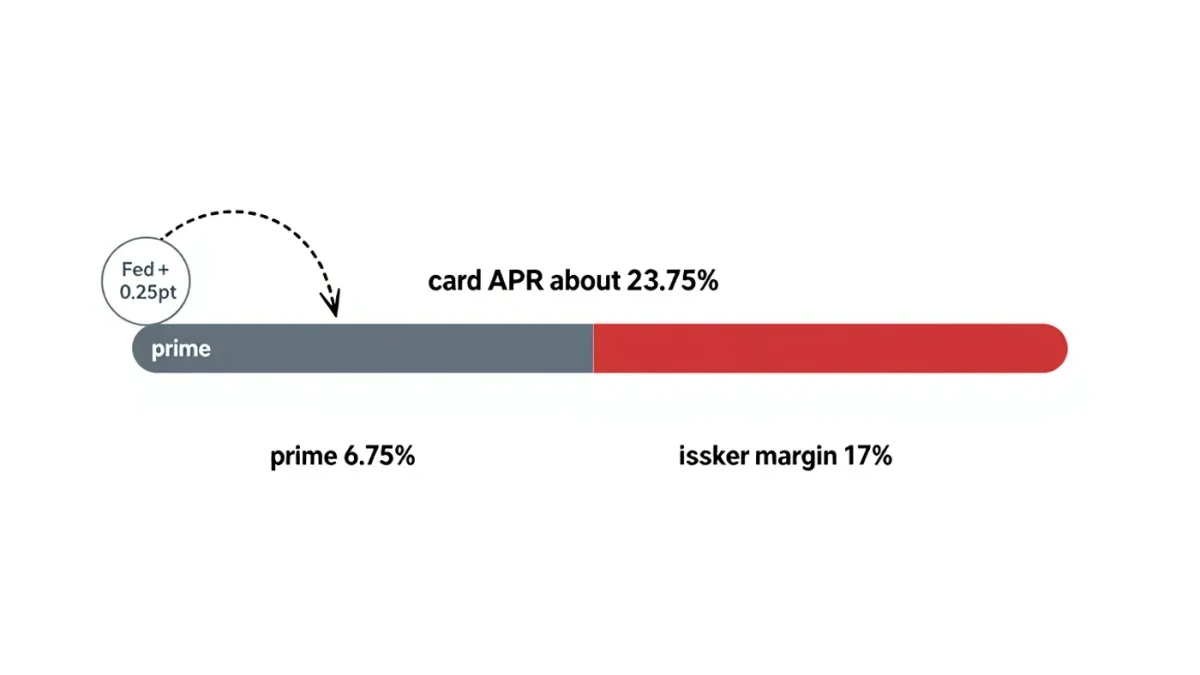
Most credit cards sold to consumers and small businesses carry variable annual percentage rates, and the variable is not a metaphor: card agreements typically price the APR as the prime rate plus a fixed margin set by your credit profile. When the Fed changes the federal funds target, prime moves in step by banking convention, and the card APR follows within one or two billing cycles. That contractual link makes card interest one of the fastest-transmitting prices in the economy — faster than your fixed loans, and always in the direction you would rather it were not.
The scale explains the stakes: card rates have run above 20 percent on average in recent years, per Consumer Financial Protection Bureau market reporting, and the margin over prime is where issuers earn.
How does the pass-through actually work?
Your cardholder agreement names an index — usually prime, sometimes SOFR — and a margin. A card at prime plus 13 percent reprices the month prime changes, with no notice, negotiation, or cap in most agreements. Two practical consequences follow. First, Fed moves reach your carrying cost almost immediately, so a tightening cycle lifts card APRs within a statement or two, exactly as the post-2022 period demonstrated across the market. Second, the timing is mechanical: the change appears on the statement after the index change posts, which makes it forecastable — you can read the FOMC calendar and predict your own interest rate a month ahead.
Why is the margin so large?
Because cards are unsecured, revolving credit with high loss rates and no collateral. The margin covers issuer losses, rewards funding, and acquisition cost, and it is priced to your credit file at application — largely fixed thereafter. This is the strategic point for operators: the part of your APR that responds to the Fed is not the part worth negotiating. Balance-transfer offers, competitor cards, and small-business cards with introductory periods compete on the margin, and a business carrying a card balance should requote it the way it requotes insurance — periodically, and especially after credit improves.
What can a small business do about it?
The hierarchy is boring and effective. Paying the statement in full eliminates APR from the conversation entirely, converting the card into a float-and-rewards tool. If a balance must ride for a season, move it to where balances belong: a business line of credit priced near loan rates rather than card rates, or an introductory-rate balance transfer with the transfer fee amortized against the interest saved — with the discipline to clear it before the intro period ends, since the rate that follows is usually worse. And treat any card balance older than two statements as a financing decision to be made deliberately, not a habit to be serviced.
What about caps and protections?
Variable card APRs generally have no ceiling unless the agreement states one, and there is no federal cap on card interest rates; state usury laws largely do not bind national issuers. The CARD Act's protections — notice requirements and restrictions on rate increases on existing balances — apply to consumer cards and to many small-business cardholders only through issuer policy, since business cards sit outside most of that statute. The operative protection is therefore contractual and behavioral: know your index and margin, watch the FOMC calendar, and never let a rate that reprices monthly carry a balance you did not choose.
- Variable APR = prime + your margin; it reprice within 1–2 cycles
- The Fed moves the index; your credit moves the margin
- Full payment makes APR irrelevant; lines of credit carry balances cheaper
- Business cards lack most CARD Act protections
Card interest is the one borrowing cost you can forecast a month out, from a public calendar. That is worth exactly as much as the balance you are carrying when the calendar turns.