Business credit is a separate financial identity for your company, held by business credit bureaus — Dun & Bradstreet, Experian Business, Equifax Business — and scored for lending by tools like FICO's Small Business Scoring Service. The point of building it is to borrow on the company's own standing: better rates, higher limits, and eventually less reliance on your personal guarantee, which is what separates business risk from your house.
The mechanism is unglamorous: creditors report payment experiences to the bureaus, scores form from them, and lenders look. Your job is to make sure the reporting happens and stays clean.
How do you start the file?
Establish the legal and administrative base first: the entity formed, an EIN from the IRS, a dedicated business bank account, a business address and phone listed consistently everywhere. Then register: a D-U-N-S number from Dun & Bradstreet is free and is the key that opens your D&B file — many federal grant and contract applications require it anyway. Inconsistency is the silent killer: a business whose address and name vary across registrations and accounts looks, to a bureau's matching logic, like several small files or none.
Which accounts actually report?
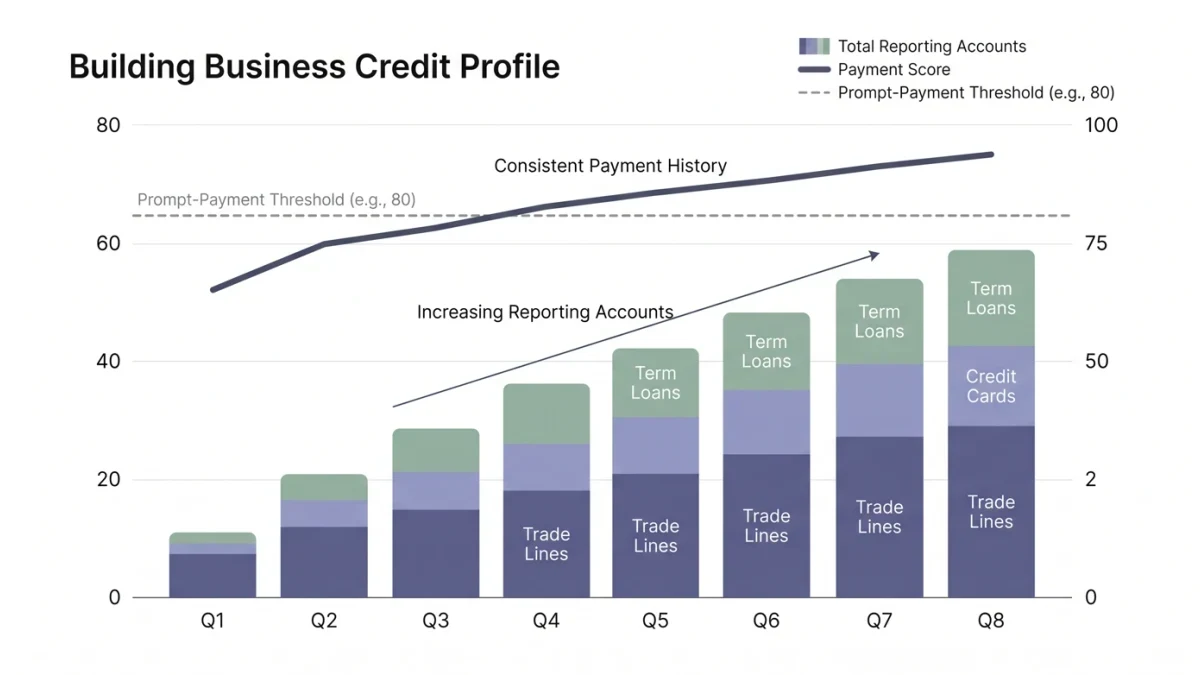
Here is the step most owners miss: most vendors and card issuers do not automatically report to business bureaus. Trade references — suppliers extending net-30 terms — report only if they choose to or if you ask, and some bureaus accept direct trade-reference submissions. Business credit cards from major issuers usually report to at least one business bureau. The practical sequence: open accounts known to report, keep them active, and pay early rather than merely on time — D&B's Paydex score, for instance, marks 80 as prompt payment and rewards payment ahead of terms. Three to five reporting accounts paid cleanly for a year is a real profile.
How do personal guarantees fade?
Gradually and conditionally. Most small-business credit starts personally guaranteed — issuers underwrite the owner early on. The path out is a thickening business file plus demonstrated repayment: as the business shows years of reported, on-time trade lines and its own banking history, more credit becomes available on company-only terms, and existing guarantees can sometimes be renegotiated on renewal — burn-down provisions are worth asking for explicitly. What never works is the shortcut: shelf corporations and "guarantee-free credit in 30 days" schemes sell purchased tradelines of no lending value, per repeated Federal Trade Commission consumer warnings about credit-repair schemes.
What damages the file?
Late payments and defaults, obviously. But also thin files left dormant, mixed personal-and-business activity that muddies both profiles, and public records — liens, judgments, UCC filings from prior financing — which sit on business reports prominently. Monitor the file like a personal credit report: bureaus make current reports available directly, and errors in business files are at least as common, with a dispute process that works only for those who check.
- EIN, dedicated account, consistent name and address everywhere
- Get a D-U-N-S number; it is free
- Use vendors and cards that actually report
- Pay early — prompt beats merely on-time
Business credit is slow capital: twelve to twenty-four months of deliberately reported, cleanly paid accounts. Built once, it prices every future dollar the firm borrows.