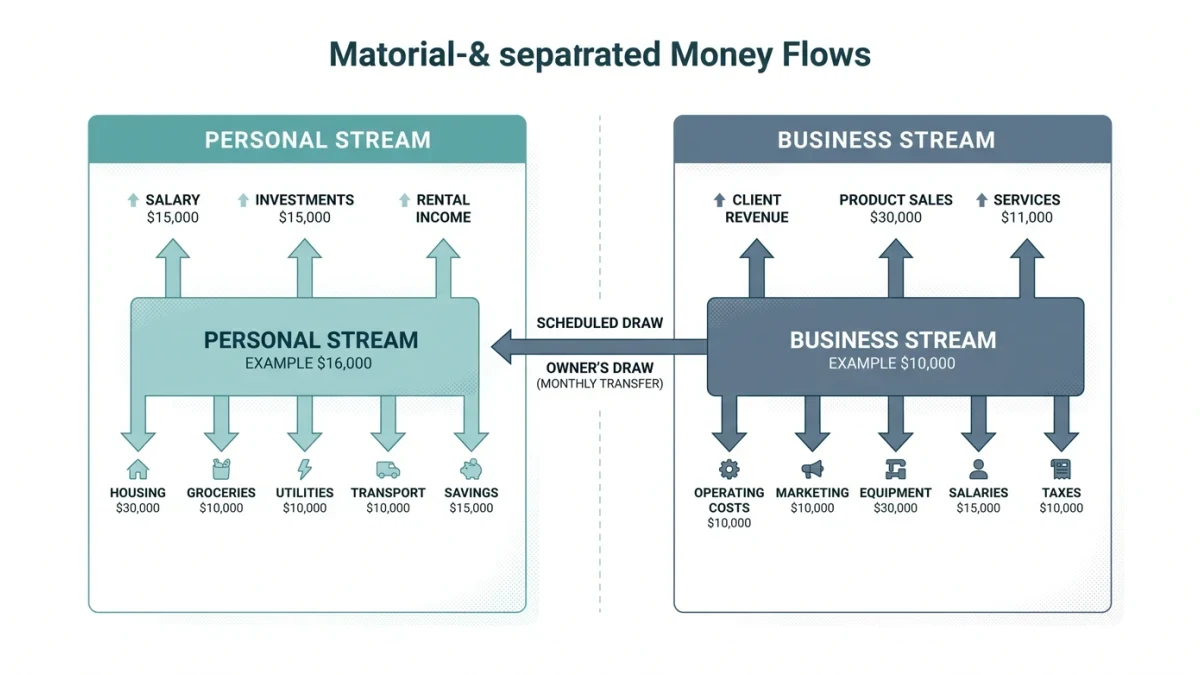
Commingling funds — paying business costs from a personal card, sweeping business revenue into a personal account — is the single most common structural mistake small owners make, and its cost is quiet until it is not. The IRS requires business expenses to be substantiated; pulling them out of a personal statement full of groceries and tuition is how legitimate deductions die in an audit. And for LLC owners, the personal liability shield exists only as long as the entity is treated as separate — courts have pierced the veil precisely because the owner did not. Orer News publishes information, not financial or legal advice.
The fix costs a monthly fee, if that, and returns it in audit posture, liability protection, and the hours you currently lose reconciling mixed statements by memory.
What does the IRS actually require?
Business deductions must be ordinary, necessary, and substantiated with records. A dedicated account makes every transaction inherently documented — date, amount, counterparty — without receipts hunting. The alternative, reconstructing which Amazon charge was inventory versus a birthday gift, fails routinely: unsupported allocations get disallowed, and commingled records invite scrutiny of everything else on the return. Sole proprietors are not legally required to have a separate account, which makes the practice purely a question of how much audit risk and bookkeeping pain you prefer.
What happens to your LLC shield?
The liability protection of an LLC rests on the entity being genuinely distinct from its owner. Commingling is the textbook fact plaintiffs cite to argue the entity is an alter ego and reach personal assets. The discipline is straightforward: a business account that receives all revenue and pays all business expenses, an owner contribution or draw properly recorded as equity movement rather than personal spending, and no business payment ever made from a personal instrument when the business can pay it directly.
What does it do for taxes and bookkeeping?
A clean account feed cuts tax preparation cost — most CPAs charge for time spent classifying junk transactions — and turns quarterly estimates into arithmetic instead of archaeology. It also produces the financial statements lenders ask for: a business credit line application backed by twelve months of clean business bank statements underwrites faster and better than one requiring explanations of every personal transfer. Banks themselves typically require a business account anyway before issuing merchant services or business credit in the entity's name.
How do you run it day to day?
Practical rules keep the wall standing. Pay yourself a defined owner's draw on a schedule rather than dipping at will. Route every recurring business cost — software, subscriptions, fuel, phone — to the business account or a business card. When a personal card must cover something, record it as an owner contribution or reimbursement immediately, not at year-end. And if the account runs short in early months, fund it with a recorded contribution instead of paying the bill personally; same money, different legal meaning.
| Practice | Effect |
|---|---|
| All revenue into business account | Clean substantiation, audit-ready |
| Scheduled owner draws | Veil respected, books honest |
| Business card for recurring spend | Auto-categorized expenses |
| Recorded contributions when short | Equity trail instead of commingling |
| No personal bills from business | Protects deductions and shield |
The separate account is not bureaucracy; it is the cheapest compliance product on the market. Everything downstream — the LLC's shield, the audit file, the loan application, the quarterly estimate — inherits its cleanliness.