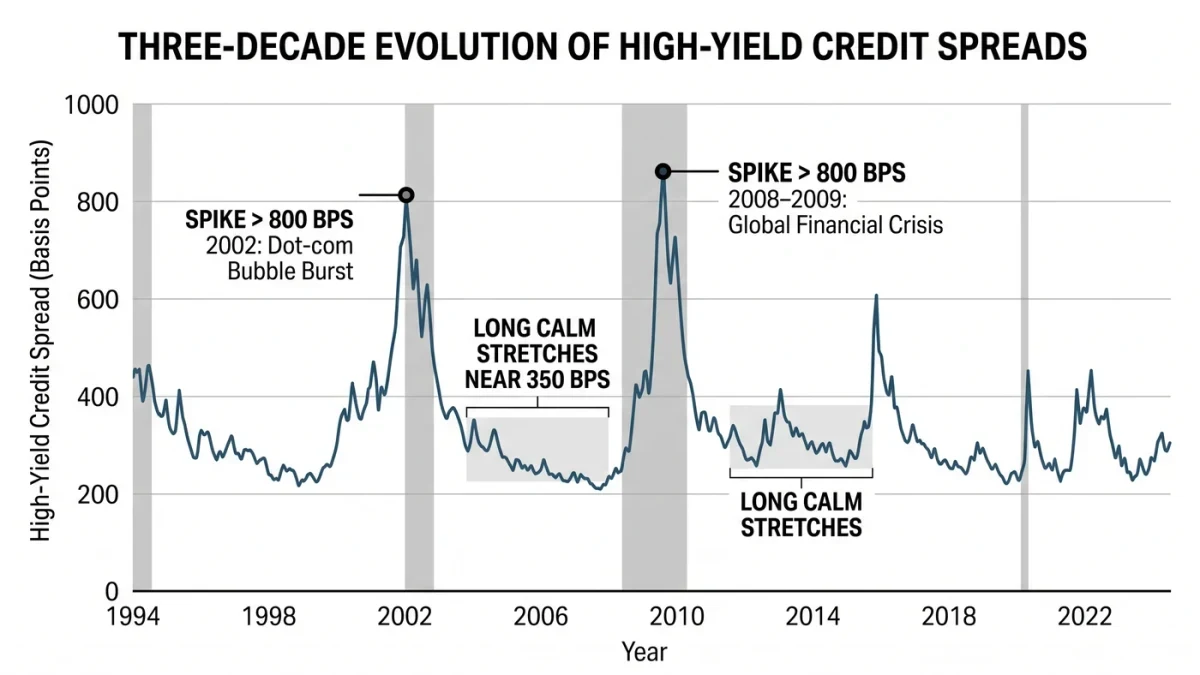
Your business borrowing rate has two parts: the risk-free baseline the Fed and the Treasury curve set, and the spread — the premium lenders charge for the chance you do not pay them back. Credit spreads in the corporate bond market are that premium measured daily at institutional scale, and they are the transmission line between financial-market stress and the actual cost of a mid-sized company's debt. The Fed can cut rates into a widening-spread environment and leave real borrowing costs barely moved, which is exactly what happened during the 2008 and 2020 stress episodes. Orer News publishes information, not financial advice.
The practical proxies are published daily: the ICE BofA high-yield index spread over Treasuries and the TED-style measures that track bank funding stress — all readable without a terminal, and all summarized in Federal Reserve market commentary.
What is a spread, mechanically?
A corporate bond yields the matching Treasury plus a spread. Investment-grade firms pay narrow spreads; below-investment-grade — high-yield — issuers pay wide ones. The spread moves with two forces: default expectations in the real economy, and lender risk appetite — how much capacity and willingness banks and funds have to hold risky paper. The second force is why spreads can widen sharply even when the macro news is merely uncertain: lenders pull back first and ask questions later.
How does that reach a small business?
Through every non-bank and risk-priced channel: online lenders' rates, factoring advance rates, mezzanine and private-credit pricing, MCA (merchant cash advance) factors, and bank credit-line terms for weaker credits. When high-yield spreads widen, private-credit funds' own costs rise and their willingness to fund small and mid-size borrowers falls; banks reprice their riskiest tier and tighten covenants. The 2022–2023 tightening cycle demonstrated the mechanism in slow motion: policy rates rose, but the spread component on risk-priced small-business credit rose far more proportionally, which is why online-lender rates climbed even where bank loan rates moved less.
What should an operator do with spread-watching?
Use it as a financing calendar. Spreads tight: the environment favors refinancing, terming out revolving balances, and locking multi-year fixed debt, because risk appetite is doing you a favor that will not last. Spreads widening: move borrowing needs forward in time if you can — establish or expand the credit line before, not after, the stress print; lenders' willingness to extend new commitments collapses fastest at exactly the moment you need them. And read spread direction alongside the Fed: cuts plus widening spreads means the relief you expected on your floating rate may be partly consumed by the risk premium — a distinction that decides whether a refinance actually pays.
Where can you see spreads without a Bloomberg terminal?
The Federal Reserve's Financial Stability Report and daily market commentary summarize credit conditions quarterly; FRED, the St. Louis Fed's free data service, publishes high-yield and investment-grade spread series anyone can chart. A quarterly glance at the high-yield spread series — level and direction — is enough to time the calendar; the goal is awareness of lender appetite, not day-trading corporate debt.
- Your rate = benchmark + spread; only the first is the Fed's
- High-yield spreads proxy lender risk appetite, daily and free
- Tight spreads: refinance and term out debt
- Widening spreads: secure credit lines early, defer what can wait
Benchmarks make the headlines; spreads make the invoice. Businesses that watch both stop mistaking a Fed cut for a borrowing-cost rescue.